
Stop Settling for Boring Bathrooms: 12 Black and Wood Ideas That Actually Work

Let’s be honest. Most bathrooms are boring. White walls, chrome faucets, builder-grade vanity that somehow costs more than it should. You deserve better than that.
Black and wood bathrooms are having a serious moment right now, and honestly? They’ve earned it. The combination of dark drama and warm timber creates something that feels genuinely designed rather than just thrown together. And the best part? This look works in a tiny en-suite just as well as it does in a massive master bath.
I’ve rounded up 12 real examples that actually show up in real homes, not just luxury hotel shoots. Some go full dark mode. Some keep things light and subtle. All of them have at least one idea worth stealing for your own space.
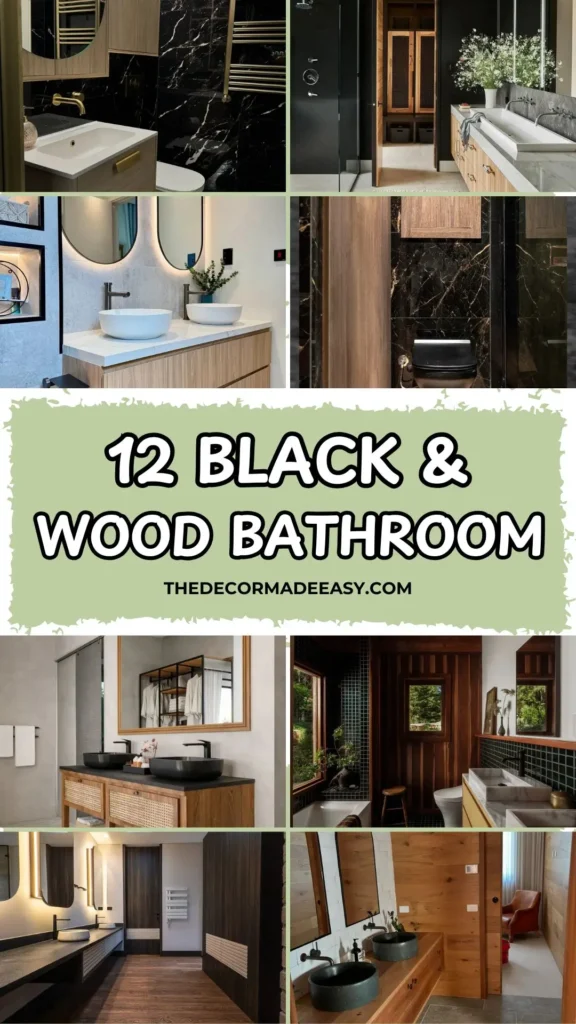
1. Black Marble, Oak Cabinetry, and Brass Hardware
This one doesn’t do subtle, and that’s exactly why it works.
Black marble tiles with white veining cover the walls, floor, and even the wall behind the toilet. Yes, all of it. The result is this incredible jewel-box feeling that you either love immediately or need a minute to warm up to. (Give it a minute. It’s worth it.)
The oak vanity and matching tall cabinet cut through all that drama like a breath of fresh air. The mid-toned wood grain doesn’t fight the marble at all. It just settles beside it like it belongs there.
Here’s the secret weapon: brass. Every single fixture, the wall-mounted faucet, the towel rail, the drawer pulls, all brushed brass. That one decision holds the entire room together. Brass lives comfortably between cool black marble and warm organic oak in a way that chrome or matte black simply wouldn’t.
A round mirror above the vanity is a quietly smart move here too. Circular shapes interrupt the grid of rectangular tiles and rectangular cabinetry, giving your eye a place to rest.
To copy this look:
- Start with black marble-effect porcelain tiles (much more forgiving than real marble, FYI)
- Go for a light-to-mid oak veneer vanity, handleless or bar-handle style
- Pick one metallic finish and stick to it throughout, brass, matte gold, or antique bronze all work
2. Matte Black Walls, Light Oak Vanity, and Textile Contrast
Most people chicken out when it comes to black walls in a bathroom. They’ll do one accent wall and call it brave. This space does the opposite and commits fully, floor to ceiling, wall to wall, deep flat black paint everywhere.
And it is so much more interesting for it.
The blonde oak vanity on one side absolutely pops against all that darkness. We’re talking seriously pale grain that creates a crisp contrast without looking jarring. A light grey marble-effect countertop adds a third tone that keeps the palette from feeling like it only has two options.
The detail I love most here is the textile layering. A kilim runner on the floor with rust, navy, and cream geometric patterns introduces actual color into a black and wood bathroom without breaking the mood. Pattern used this way reads more like texture than decoration. It’s a clever little trick.
Pendant lights with clear glass globes drop from the ceiling and scatter warm points of light across the room. When your walls are eating most of the available light, this is exactly the right call.
Budget tip: Matte black paint is your cheapest and most impactful tool in this entire style. Roll it on walls and ceiling for full commitment, then let a single light-wood vanity do all the heavy lifting.
3. Light Wood Floating Vanity with Dual Oval Mirrors and Terrazzo Floors
Not every black and wood bathroom needs to go dark and dramatic. This one keeps things airy and uses black as an accent rather than the main event.
The floating vanity has a warm honey-oak finish with no visible hardware, just subtle horizontal recesses in the drawer fronts. On top, white Carrara-look quartz and two round white vessel sinks keep everything feeling clean and fresh.
The real stars here are the mirrors. Two tall oval mirrors with thin black rims hang above each sink, backlit with a soft halo effect against the concrete-look wall panel. Oval shapes feel less expected than the standard round mirror, and using two creates symmetry without being rigid about it.
A series of square niches with black frames on one wall adds geometry and open storage that doubles as display shelving. Very smart use of wall space.
The terrazzo floor ties everything together in a way that plain tile simply couldn’t. Its white base with flecks of rust, green, and charcoal echoes the wood warmth and the graphic black frames without competing with either.
This is the perfect approach for shared bathrooms where one person wants drama and the other wants to actually feel awake at 7am. White walls and ceiling keep the space feeling open, while black accents deliver the visual edge.
Also Read: The “Scary” Modern Black Bathroom: 12 Ideas That Actually Work (Without Feeling Like a Cave)
4. Matte Black Wall-Hung Toilet Against Black-Gold Marble with Dark Wood Panels
This example is a tight detail shot, not a full room reveal. And it’s more useful for it.
Here’s the setup: a matte black wall-hung toilet sits against slabs of black marble tile with dramatic gold veining. To one side, a dark walnut panel runs floor to ceiling with tight horizontal grain. At the base, strips of lighter wood alternate with the walnut creating a graphic detail that feels almost architectural.
Specifying a matte black toilet instead of white is a genuinely interesting choice. White fixtures against dark backgrounds create a stark contrast that can feel clinical. A black toilet against black marble reduces that contrast and lets the marble’s surface texture and veining become the actual focal point. The toilet almost disappears into the wall. In the best possible way.
The gold veining in this marble is neither subtle nor over-the-top. It has real character that grounds the luxury feel of the whole composition. Pair it with walnut that has genuine warmth in its undertone and you get something that feels expensive without screaming about it.
If you’ve got a hesitant partner who thinks a black toilet sounds like a terrible idea, show them this photo. Context changes everything.
5. Walnut Butcher Block Top, Matte Black Drawer Fronts, and Matching Vessel Sinks
This might be the most copy-able vanity setup in this entire list, and I mean that as the highest possible compliment.
The concept is beautifully simple: a wall-mounted floating unit with matte black drawer fronts, topped and wrapped in warm walnut butcher block. Two matte black square vessel sinks sit directly on the wood surface. Two matte black faucets rise above them. That’s it.
The restraint here is what makes it work. Every single element is either black or walnut. No third color, no metallics, no competing textures. The grey concrete-look floor tile below quietly does its job without demanding attention. Frameless mirrors above keep the visual weight on the vanity where it belongs.
Here’s what I find genuinely fascinating about this pairing: matte black is almost aggressively inert. It absorbs light and gives nothing back. Butcher block walnut does the exact opposite. Every plank has micro-variation in grain and tone, and it responds dynamically to changing light throughout the day. Put these two materials side by side and each one makes the other look more like itself.
The square black vessel sinks carry real architectural weight too. They read as objects in their own right, not just functional fixtures dropped onto a counter.
IKEA hack potential here is massive:
- Black SEKTION or AXSTAD cabinet fronts
- Custom walnut slab on top
- Aftermarket matte black vessel sinks and faucets
- Total cost can be a fraction of a custom build
6. Dark Brick-Style Black Tile Wall with Walnut Vanity, Marble Counter, and Brass Sconces
The tile in this bathroom isn’t trying to be marble or concrete or anything else. It’s a straightforward rectangular brick-format tile in deep charcoal-black, laid in a running bond pattern with slightly visible grout lines.
That texture, the repetition of that brick form across the entire feature wall, is what makes the space feel substantial rather than just dark. There’s a huge difference between dark and heavy, and this tile achieves both in a way that feels grounded rather than oppressive.
Against it, the walnut vanity does serious work. This is a rich reddish-brown walnut with an open, varied grain, not the pale blonde oak from earlier examples. It has real visual weight. Small black drawer pulls keep attention on the wood rather than the hardware.
The brass fixtures are the connective tissue that holds it all together. The widespread faucet in aged brass picks up the warm red undertones of the walnut. Two pendant sconces with glass cylinder shades over brass bodies introduce vertical light that grazes the brick tile and reveals its surface texture. Recessed lighting would flatten this completely. Don’t use recessed lighting here.
The rounded-rectangle mirror with a thin black frame sits slightly proud of the wall, giving it a dimensional quality. It’s positioned between the two sconces at standing eye level, which sounds obvious but is surprisingly often ignored.
Also Read: 10 Black Marble Bathroom Ideas That Will Make You Rethink Everything You Know About Dark Spaces
7. Light Oak Cabinetry, Matte Black Hardware, and Organic Styling
This is the black and wood bathroom for people who want the aesthetic without the full commitment to drama. And there is absolutely nothing wrong with that approach.
White walls. Quiet grey stone floor tile. Light blonde oak vanity topped with generous white quartz. Nothing here is trying to be edgy.
The black arrives entirely through hardware and accessories:
- Cylindrical matte black cabinet handles
- Matte black faucet
- Matte black towel bar
- Matte black soap dispenser
- Matte black wall sconces with exposed bulbs
None of these pieces is exceptional on its own. But collectively? They create a consistent accent system that gives the whole room a clear design logic without requiring expensive tile work or scary commitment to dark surfaces.
What stops this from feeling generic is the counter styling. A tall tan ceramic vase holds a loose arrangement of wildflowers and greenery, the kind that looks gathered rather than composed. Next to it, a black ceramic vase with a slightly irregular form. Two objects, organic and imperfect, doing a lot of heavy lifting in an otherwise clean rectilinear space.
For anyone renovating a shared or family bathroom, this example makes a compelling case that you don’t need to gut the whole room. New hardware, a styled counter, and a thoughtful mirror can carry you much further than you’d expect.
8. Solid Oak Planked Walls, Dark Stone Vessel Sinks, and Arched Black-Frame Mirrors
This one goes full natural material immersion. We’re talking genuine oak planks, visible knots and all, covering the back wall and likely the ceiling. The effect is closer to a Finnish sauna than a conventional bathroom, and I mean that as a compliment.
The vanity is built from the same oak: a long, low run with small brass or bronze knobs as hardware. The countertop is wood too, which is a bold choice that commits fully to the material story.
The dark grey stone vessel sinks are essential contrast here. Deeply rounded, almost bowl-like, with a matte slightly rough surface that suggests irregular natural stone. They give the space the dark anchor it needs against all that warm timber. Wall-mounted taps in dark bronze complement them without matching exactly.
Two arched black-frame mirrors above complete the composition. The curved tops echo the rounded sinks below, and that arch shape softens what could otherwise feel aggressively rustic.
Small off-white handmade ceramic tiles on one wall add textural counterpoint and create a visual boundary between the sink zone and the wood-heavy surround without introducing any new color.
This look works best in rural or coastal settings where the surrounding environment can contribute to the atmosphere. Natural light through a window with an interesting view takes it to another level entirely.
9. Dark Walnut Panels, Engineered Oak Flooring, and Skylight Illumination
Long narrow bathrooms are genuinely tricky. Most renovation advice treats the shape as a problem to minimize. This bathroom uses the length as an asset instead.
A smoked oak wall panel runs the entire right side from floor to ceiling. On the opposite side, a continuous floating vanity stretches the full length with two sinks, two ribbed oval mirrors in warm brass frames, and two backlit panels above them. That rhythm turns a corridor-like space into something that feels purposeful and intentional.
The flooring detail makes this room. Wide-plank engineered oak in a warm espresso finish, planks running lengthwise, creates a visual anchor that resists the space’s natural tendency to feel narrow. Wide planks running in the long direction are the oldest trick in the narrow-room playbook, and it works every time.
Two skylights in the ceiling are critical here. Dark wall panels and dark flooring with only artificial light would feel genuinely oppressive. Natural light from above maintains openness in a way that side windows in a narrow room often can’t provide. The skylights also make that warm oak floor glow in a way artificial lighting approximates but never quite replicates.
Quick framework for long narrow bathrooms:
- Commit to one dark feature wall
- Keep the opposite wall lighter
- Use wide-plank flooring running lengthwise
- Add skylights if structurally possible (transformative)
Also Read: 10 Black Bathroom Vanity Styles That Prove Dark Furniture Isn’t Scary
10. All-Black Sloped Attic Bathroom with Wood-Look Tile Floor
Attic bathrooms come with constraints that most renovation guides tell you to work around. This one leans into them completely.
The angled ceiling and irregular wall geometry are finished entirely in matte dark grey microcement, creating a dramatic cave-like enclosure. Someone made a decision to stop fighting the architecture and just embrace it, and that decision made everything else possible.
The contrast comes from the floor: large-format wood-look porcelain tiles in a warm honey tone. They read as genuine timber from any normal viewing distance. The warm color does everything the space asks of it, grounds the room, introduces organic warmth, and prevents the all-dark surfaces from becoming oppressive.
Lighting is placed with real intention here. A backlit round mirror provides task lighting at the sink and creates a focal point on an otherwise featureless dark wall. Below the vanity, a strip of warm LED underlighting glows amber, lifting the unit off the floor visually and adding ambient warmth that the mirror light alone couldn’t deliver.
The attic window with its raw timber frame connects the room to the outside world. Natural light floods in during the day. At night, that window frame glows like a lantern against the dark interior.
For attic conversions: commit to the darkness rather than fighting it. Dark plaster or microcement on the sloped surfaces, warm-toned wood-look floor, and carefully placed warm lighting will get you there.
11. Rattan-Front Oak Vanity with Black Vessel Sinks and Warm Wood Mirror Frame
This one brings a third element into the black and wood conversation: rattan. The vanity is an open-leg timber construction with rattan-paneled drawer fronts, shifting the whole aesthetic toward warm resort-influenced design.
The medium amber oak and rattan weave combination adds tactile softness to what would otherwise be a fairly structured composition. On top of a matte black countertop, two rounded matte black vessel sinks in slightly different profiles, one rounder, one slightly oval, sit alongside tall straight matte black faucets.
Those sinks are the boldest design statement in the room. Their deep matte finish, rounded forms, and slightly irregular character suggest cast stone rather than ceramic. They make you want to touch them, which is a quality that very few bathroom fixtures achieve.
Above the vanity, a large mirror with a solid wood frame in the same amber oak hangs centrally. Its generous size fills most of the wall above the unit. Choosing the same wood species for the mirror frame as the vanity is the detail that unifies the palette. A metal-framed mirror here would disconnect everything.
The open base of the vanity, with rattan baskets and folded towels visible underneath, creates a boutique hotel quality. This is displayed storage, which only works when every item underneath has been thoughtfully placed. (No hiding the random bottles of shampoo you’ve had since 2019.)
Good news: many furniture retailers now offer rattan-panel vanities. The matte black vessel sinks and faucets are widely available. This is one of the more achievable looks in this whole list.
12. Dark Cedar Ceiling, Black Mosaic Tile, and Warm Oak Vanity with Forest Views
This is the most immersive bathroom in the entire roundup, and it knows it.
Dark cedar planks line the ceiling and vertical wall dividers, creating a warm structural canopy. Below that, small deep black-green square mosaic tiles cover the shower area, floors, and lower vanity wall. Against all that darkness, the white soaking tub, white toilet, and marble sink surfaces read with vivid, almost startling clarity.
The blonde oak floating vanity on one side is the lightest element in the room. Marble vessel sinks reinforce that lightness. A matte black faucet bridges the two zones without creating a jarring transition between warm and dark.
What defines this room above everything else is its connection to the outdoors. Multiple windows framed in the same dark cedar as the ceiling frame views of dense green trees. The outside isn’t decoration here. It’s an active design element. The dark mosaic tile seen against that backdrop of green looks like shadow on water. The cedar ceiling lit from below takes on the character of a forest canopy.
This is a bathroom built around an idea, not just a style. The idea is complete immersion in natural material, wood, stone, darkness, and light filtered through trees. Every decision serves that idea.
You don’t need forest views to borrow these principles:
- Small dark mosaic tile for floor and shower
- Warm wood structural elements at ceiling or wall level
- White marble as contrast
- Prioritize natural window light over artificial lighting wherever possible
Which Black and Wood Bathroom Approach Is Right for You?
Before you commit to anything, here’s a quick breakdown to help you figure out where to start:
If you want full drama:
Go black marble with brass hardware and oak cabinetry. Best for small en-suites or cloakrooms where the jewel-box effect actually works in your favor.
If you want something softer:
Try the light oak vanity with matte black hardware approach. Works in any bathroom, any size, and you can get there with existing cabinetry and new fixtures.
If you’re working with a tricky layout:
Long narrow bathroom? Wide-plank flooring running lengthwise and one dark feature wall will transform it. Attic bathroom? Lean into the darkness and use warm-toned wood-look tile underfoot.
If you want to test the water first:
New matte black hardware on an existing light wood vanity is genuinely available to almost any bathroom with zero structural work involved. Start there.
The Bottom Line
Black and wood bathrooms work because the combination isn’t arbitrary. Black absorbs light and creates depth. Wood reflects warmth and introduces organic irregularity. Each material makes the other look more like itself. That’s not a trend, that’s just good design logic.
The 12 examples here span wildly different budgets, room sizes, and design personalities. What they share is commitment. Half-measures produce neither the drama of a dark bathroom nor the warmth of a wood-forward one. Pick a direction, then actually go there.
The simplest version, swapping hardware and styling your countertop, is something you could do this weekend. The most ambitious version takes planning, skilled trades, and careful material selection. Both are genuinely worth pursuing, because a bathroom that feels designed is one you’ll actually enjoy using every single day.
Now go steal one of these ideas. Your bathroom has been waiting long enough.


One Comment