
How to Go Dark Without Feeling Doped: 12 Lessons in Black Bathroom Design

Let me guess. You love the idea of a black bathroom, but something keeps stopping you. Maybe it’s the fear it’ll feel like a cave. Maybe someone in your life keeps saying “it’ll make the room look smaller.” Maybe you’ve just been playing it safe with greige walls for so long that going dark feels genuinely terrifying.
Here’s the thing though: every single person I’ve seen walk into a well-done black bathroom has that same reaction. Their eyes go wide, they go quiet for a second, and then they say “okay, I get it now.”
That’s what this article is for. I’ve pulled together 12 real, stunning black bathroom ideas, ranging from full-on moody drama to subtle dark accents, so you can finally see what’s actually possible. At least one of these will speak directly to whatever vision you’ve been sitting on.

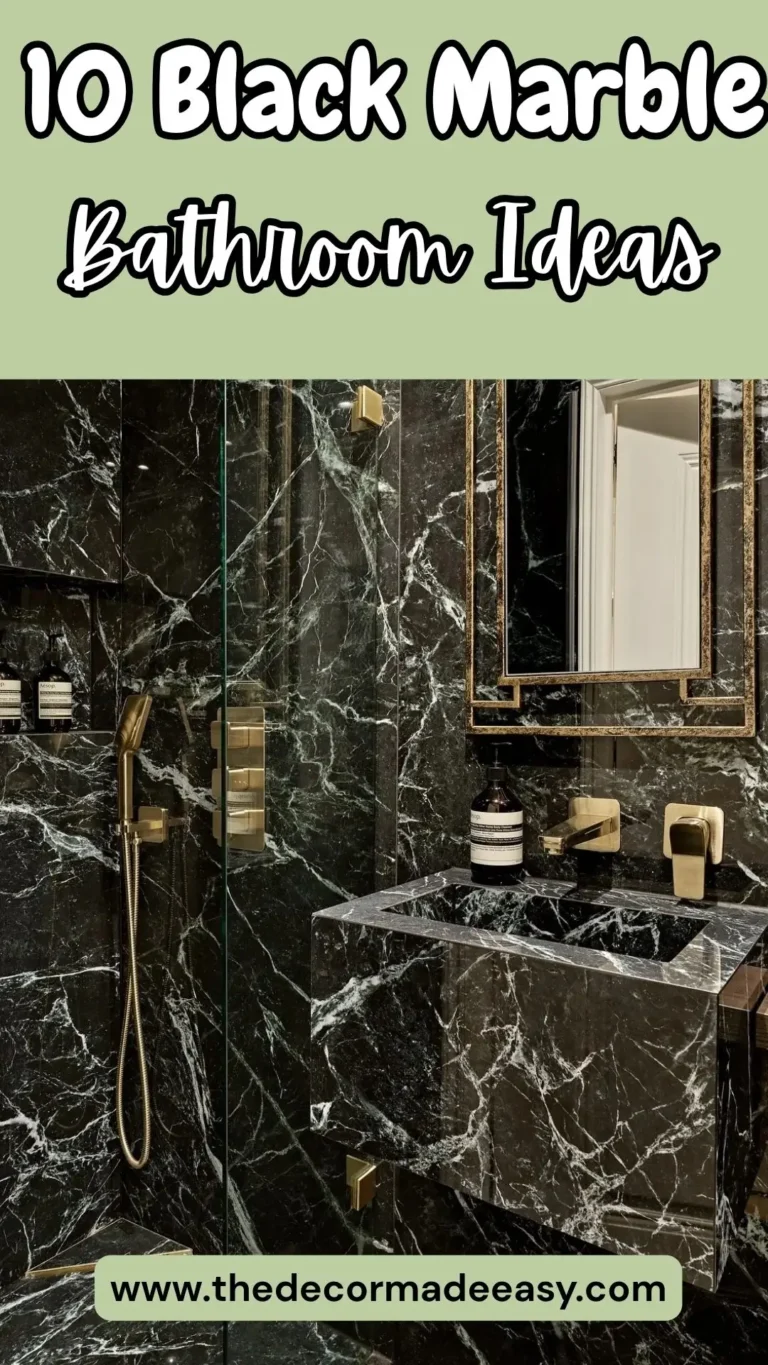
1. Dark Marble Powder Room with Gold Mirror and Sculptural Tile Wall
This one opens strong, and honestly it sets the bar high for everything that follows.
Every surface in this powder room is dark. Charcoal-gray matte walls wrap the entire space like a jewel box, and the right-side wall features floor-to-ceiling sculptural tile with an organic wave relief pattern in deep pewter. Light hits those undulating surfaces differently throughout the day, so the room always feels alive even when nothing’s moving.
The vanity is a sleek black console with chrome legs, minimal and almost architectural, topped with a matching black basin sink. Above it? A gold sunburst mirror flanked by two crystal wall sconces casting warm amber light. That trio cuts through the darkness beautifully without feeling overdone.
The floor brings it home with black marble penny tiles edged in white veining, adding a softer circular counterpoint to all those sharp angles above.
The reason this works is restraint within abundance. Every dark element earns its place because the gold and crystal accents stop things from tipping into oppressive territory.
Pro tip if you want to recreate this: Pick one metallic finish and use it at least three times. Mirror frame, sconces, and faucet hardware at the absolute minimum. Half-measures in a dark bathroom look unfinished, not daring.
2. Gallery Wall WC in a Deep Black and Forest Green
Okay, I’ll be honest. I used to roll my eyes at gallery walls in bathrooms. They always felt like someone had too many prints and ran out of hallway space.
This example completely changed my mind.
The upper walls are painted near-black while the lower half features deep forest-green vertical tongue-and-groove paneling. The split happens just above chair-rail height, which feels proportionally perfect. Four framed prints sit in a deliberate gallery arrangement: two large botanical illustrations in the Audubon style, flanked by two smaller antique map prints. White mats and dark frames make each piece pop dramatically against the dark wall.
A gold-framed ornate mirror partially visible on the right adds a vintage twist that you didn’t know you needed.
The floor is a classic black-and-white geometric encaustic tile that ties everything together without fighting the walls for attention. A wall-hung white ceramic toilet and a floating wood-toned vanity keep the fixtures fresh and contemporary.
The big takeaway here: A black bathroom doesn’t have to feel sparse to feel sophisticated. Dark walls are genuinely the best gallery backdrop you can create. Go for white mats on whatever prints you choose because that white border is what makes everything visually separate and pop.
3. Black Vanity and Sage Green Shower Tile with Geometric Checker Floor
This bathroom takes real design nerve. And it pays off spectacularly.
Inside the shower, floor-to-ceiling handmade-look zellige-style subway tiles in soft sage green catch light differently throughout the day. Natural color variation across each piece gives the shower this almost gemstone quality. Brushed brass fixtures including a rain head, wall-mount tap, and glass door hardware add warmth against both the sage and the black.
Outside the shower, dark matte surfaces take over completely. The black shower base, dark vanity cabinet, and black-edged mirror create a continuous dark framework that makes the green interior feel like a gem set in a ring. IMO, that contrast is the whole magic trick here.
The floor runs a bold black-and-white geometric pattern with small triangular shapes arranged in a 3D optical illusion repeat. It sounds like a lot, but it grounds the space perfectly.
The detail most people miss: It’s not just the color contrast doing the work. It’s the finish contrast. Matte dark exterior against glossy reflective green tile interior. That difference in sheen is what gives the space its energy. A matte sage tile would lose the jewel-like quality entirely.
Also Read: How to Style a White Tile Bathroom: 10 Real-Life Designs to Copy
4. White Freestanding Tub Against Black Venetian Plaster Walls
This is the one that makes people stop scrolling.
A pure-white rectangular freestanding soaking tub sits directly against walls finished in hand-applied black Venetian plaster. The plaster surface has visible brushwork in gray and silver tones layered over the black base, creating a finish that looks like oil paint. Organic, one-of-a-kind, and genuinely breathtaking.
A wrought-iron orb chandelier hangs centered above the tub, its candlestick-style bulbs casting warm light that highlights every brushstroke on the walls. The ceiling is finished in high-gloss white, which reflects that chandelier light back down and stops the dark walls from swallowing the room whole. That glossy ceiling is a move most people wouldn’t think of, but it fundamentally changes how livable the space feels.
A frameless glass walk-in shower on the right side uses large-format gray stone-look tiles to keep the sophistication going. White marble-look floor tiles throughout keep the ground plane open and light.
Real talk: This approach isn’t for everyone. But for anyone willing to commit, black Venetian plaster creates a bathroom that looks genuinely unlike anywhere else. One critical note: hire a specialist plasterer, not a general painter. The difference in result is not subtle.
5. Black Marble and Deep Burgundy: A Bold Color Pairing That Shouldn’t Work But Does
This one comes from Dezone Innovations and it sits firmly in the “this looks wrong on paper but is absolutely stunning in reality” category.
Deep burgundy-red vertical wall tiles pair with black marble surfaces throughout, including the countertop, toilet surround, and flooring. A globe-style wall sconce in warm white creates a dramatic halo effect against the burgundy tile. The black marble has prominent gray and white veining running through it, which saves it from reading flat or heavy.
A matte black wall-hung toilet with a concealed cistern continues the monochromatic lower half of the room. Burgundy cabinets and a recessed niche with warm amber strip lighting bring the upper half to life. White magnolia branches in a vase add organic softness that the hard materials genuinely need.
What this design proves: Black doesn’t have to be paired with white or neutrals to succeed. Deep jewel tones like burgundy, forest green, or cobalt can sit alongside black marble in ways that feel far more interesting than conventional pairings.
Here’s a quick material breakdown for anyone planning something similar:
| Design Element | Material | Finish |
|---|---|---|
| Vanity countertop | Black Nero Marquina marble | Honed |
| Wall tile (upper) | Ceramic | Glossy vertical stacked |
| Toilet | Ceramic with black seat | Matte black |
| Cabinetry | MDF/wood | Matte burgundy lacquer |
| Floor | Black marble | Polished |
| Lighting | Globe wall sconce | Warm white |
The rule to take from this: If you’re going bold, commit to both elements equally. A timid burgundy accent against black marble would disappear entirely.
6. Black Botanical Wallpaper with Gold Chinoiserie Detail and Brass Hardware
Chinoiserie has been a thing in Western interiors for centuries. And looking at this bathroom, it’s really easy to understand why.
The walls are covered in deep black wallpaper featuring delicate gold bamboo, tropical leaves, and flowering branches in a flat illustrative style that reads as both antique and totally contemporary. The pattern is dense enough to feel immersive but fine enough in line weight that it never becomes overwhelming.
The black vanity is a traditional shaker-style piece with multiple drawers, topped with a crisp white quartz countertop and undermount sink. Brass hardware on the drawers, a brass single-hole faucet, and a matching brass wall sconce maintain a warm metallic thread through the whole design. A black-framed vanity mirror with a gold inner edge ties the dark cabinetry to the gilded wallpaper perfectly.
My favorite detail in this whole image is the lush fern sitting on the countertop. A real, living plant against printed botanical imagery. It’s witty, it works, and it brings genuine life into the space.
For anyone who wants this look, botanical black wallpapers are available at a wide range of price points. The key is fine detailing rather than large graphic repeats, and making sure the wallpaper background color closely matches your trim and cabinetry. The tighter that match, the more integrated and intentional the whole scheme feels.
Also Read: Tired of Subway Tile? 12 Stunning Hexagon Tile Bathrooms to Inspire Your Reno
7. Black Subway Tile with Pastoral Mural Wallpaper and Crystal Chandelier
At first glance, this bathroom looks like it genuinely cannot decide what era it wants to live in. That’s entirely the point, and it is spectacular.
Matte black subway tiles cover the lower half of every wall in a standard brick bond with light gray grout lines. Above that tile line, a full panoramic mural wallpaper depicts a lush Italianate landscape: rolling hills, cypress trees, wildflowers, and soft golden light. The hard industrial tile against the romantic pastoral scene creates a tension that is completely intentional and surprisingly effective.
A small crystal chandelier with candelabra bulbs overhead signals the room’s maximalist intentions loud and clear. A matte black wall-hung toilet and a white pedestal sink keep the fixtures restrained so they don’t compete with the walls. A small round black side table holds a cactus, some rolls, and a candle. Practical and charming in equal measure.
The black-and-white encaustic cement floor adds yet another layer of pattern. By all rights, this much pattern in one room should be a disaster. Instead, the black subway tile acts as a visual mediator between the floor and the mural above, and it holds everything together beautifully.
If you want to try this at home: Yes, you absolutely can. But one caveat: invest in high-quality mural wallpaper. A pixelated or cheap reproduction would destroy the entire concept. Spend the money on the wallpaper and keep everything else on a reasonable budget.
8. Black Stone Tile Throughout with Warm Wood Vanity and Amber Strip Lighting
This is the one that converts the skeptics. It’s not theatrical or maximalist. It’s just an exceptionally well-thought-out space.
Large-format black stone-look porcelain tiles cover every wall and the entire floor in a continuous run. Subtle gray veining gives the surfaces life and movement. A frameless glass shower panel separates the wet area without interrupting the visual flow of tile across the room.
The warm wood floating vanity is the stroke of genius. Its natural grain tones, somewhere between honey oak and walnut, sit against the dark tile in a combination that feels organic and grounded rather than cold. A rounded rectangular backlit mirror provides soft even light above the white countertop basin. Black matte hardware on the vanity drawers keeps the dark framework consistent.
The thing that elevates this from good to great is the amber LED strip lighting recessed into the tiled niche inside the shower. That warm horizontal band of light creates depth and draws the eye in. It’s functional and beautiful at the same time.
FYI, if you’re going for a full-room stone tile approach: grout color matters enormously. Dark charcoal grout nearly matching the tile makes the floor read as one continuous surface. Lighter grout emphasizes the grid. Both can work, but they create very different rooms. Choose deliberately.
9. Double Walnut Vanity with Brass Lantern Sconces and Black Subway Tile Feature Wall
This is the bathroom I’d describe as “timeless but not boring.” Which, for the record, is one of the hardest design briefs to actually pull off.
The feature wall behind the vanity runs floor-to-ceiling in matte black rectangular subway tiles, dramatic but not aggressive. Everything in front of that wall is warm, natural, and refined. A wide walnut vanity with flat-front drawers runs the full width of the space, topped with a white Carrara marble countertop and two undermount rectangular sinks.
Brushed brass widespread faucets sit at each sink. Simple, well-proportioned, exactly right. Two tall black-framed rectangular mirrors hang above each sink position, with vintage-style brass lantern pendant sconces positioned between and beside them. Their Edison-style filament bulbs provide warm, flattering light that makes the whole composition glow.
A small potted plant adds color without disrupting the calm of the palette. The floor at the bottom of the frame appears to be small hex tile in white.
What strikes me most about this design is how the walnut-and-black relationship mirrors classic tailoring. The warmth of the wood against formal black creates something that reads as dressed up without being fussy.
This is also one of the most achievable looks in this entire list. Walnut veneer cabinetry is widely available, and black subway tile is among the most affordable tile options on the market.
Also Read: Stop Ignoring Your Shower: 12 Real-Life Shower Tile Ideas That Actually Work
10. Two-Tone Half Bath with Sage Lower Tiles and Oak Herringbone Floor
Small spaces are where dark bathroom design either gets really right or really wrong. This compact WC gets it beautifully right.
The upper half of the walls is painted in a flat near-black finish. The lower half features narrow-format sage green tiles laid vertically in a stacked pattern. That green ceramic section provides color and texture right where your eye naturally rests, while the black above creates a receding ceiling effect that makes the small room feel taller than it is.
A wall-hung white ceramic basin with a matte black mixer tap sits mounted on the sage tile section. A matte black wall-hung toilet with a square flush plate continues the hardware coordination. A backlit mirror on the left wall provides the only significant light source, its glow warm and directional against the dark walls.
The most unexpected element? The floor. Pale natural oak herringbone parquet. Light wood against dark walls almost always works, and the herringbone pattern adds movement without introducing another color into the mix. It warms the space significantly and stops the compact room from feeling like a closet.
The practical lesson here: In a small black bathroom, always introduce at least one warm or light element at floor level. Dark walls plus dark floors in tight spaces feel claustrophobic rather than intimate. The herringbone oak floor in this design is the difference between moody and miserable.
11. Textured Dark Navy Tile with Brass Accents and a Gold-Framed Mirror
This single vanity wall does more design work than most full bathrooms manage to pull off. And that’s saying something.
The tile is a dark navy-to-black glazed ceramic in rectangular format, laid stacked vertically with a subtle textured surface. The texture isn’t dramatic. It’s a gentle surface undulation that catches light softly and stops the large tiled surface from reading as flat. Depending on the light angle, the tile shifts between deep blue and near-black, which gives the wall a constantly shifting quality.
A rounded-rectangle gold-framed mirror sits centered above the sink, its warm metallic border glowing against the dark tile. Two slim brass cylinder wall sconces flank it symmetrically. A brushed brass single-hole faucet continues the warm metal theme at counter level.
The vanity cabinet is natural walnut with flat frameless drawer fronts. The white quartz countertop is the only truly light surface in the frame. A small floral arrangement in the lower left corner, peonies or ranunculus in blush and yellow, introduces organic softness and warmth that the otherwise cool-toned composition really benefits from.
This image proves something important about dark tile: The variation within a handmade or textured tile is worth every extra penny. A perfectly uniform glossy factory tile in the same dark navy would give you a colder, harder, less alive result. Before you commit to any dark bathroom tile, hold a sample up in your actual room lighting conditions. It makes a bigger difference than you’d expect.
12. Fluted Black Accent Wall with Concrete Countertop, Walnut Cabinetry, and Terrazzo Floor
The final entry might be the most confidently contemporary design in this entire collection.
The focal wall behind the double-sink vanity features deeply fluted black panels with vertical ribs running floor to ceiling. Those ribs cast their own internal shadow lines and create a surface of extraordinary textural depth. Two round frameless mirrors of generous diameter sit in front of the fluted backdrop, with a single slim rectangular sconce mounted between them providing centered, even light.
The vanity runs wide with two undermount rectangular sinks set into a poured concrete-look countertop in a warm greige tone. Solid walnut cabinet beneath with flat-front drawers creates that now-familiar warm-wood-against-dark contrast, but here the concrete top gives the combination a slightly more industrial, less precious quality than marble would. Matte black faucets integrated directly into the concrete surface keep the hardware aesthetic sleek and minimal.
The floor is terrazzo in a dark base with white, cream, and gray aggregate chips. Terrazzo has had a massive revival lately and honestly it deserves every bit of it. Durable, unique in patterning, and sitting in that rare zone between traditional and contemporary that makes it essentially impossible to date.
Small succulents on the countertop add the only organic note in an otherwise entirely architectural composition.
What the fluted wall teaches us: Texture alone can carry an entire design scheme. No color variation, no pattern, no mixed materials needed. The shadow play from those vertical ribs is genuinely enough. And if you’re drawn to this look, fluted MDF panels painted in deep matte black are a surprisingly accessible route to achieving a similar effect without custom millwork.
Quick Reference: Which Black Bathroom Style Suits You?
| Style | Best For | Key Elements | Difficulty |
|---|---|---|---|
| Dark marble powder room | Small, high-impact spaces | Sculptural tile, crystal sconces, gold accents | Advanced |
| Gallery wall WC | Personality-led renovations | Botanical prints, paneling, patterned floor | Medium |
| Sage and black shower | Full bathrooms, modern homes | Zellige tile, brass hardware, geometric floor | Medium |
| Venetian plaster walls | Statement master bathrooms | Freestanding tub, chandelier, gloss ceiling | Advanced |
| Black marble + jewel tones | Contemporary, design-forward spaces | Colored tile, concealed cistern, strip lighting | Advanced |
| Chinoiserie wallpaper | Traditional homes, powder rooms | Gold botanical paper, brass hardware, plants | Easy |
| Mural above subway tile | Eclectic, maximalist spaces | Pastoral wallpaper, chandelier, encaustic floor | Medium |
| Full stone tile with wood vanity | Modern family bathrooms | Large-format tile, floating vanity, LED niche | Medium |
| Double walnut vanity, black tile | Master bathrooms | Carrara marble top, brass lanterns, subway tile | Medium |
| Two-tone with herringbone floor | Small WCs and half baths | Sage lower tile, light oak floor, backlit mirror | Easy |
| Textured navy tile, brass accents | Single-wall vanity designs | Textured tile, gold mirror, brass sconces | Easy |
| Fluted panels + terrazzo floor | Contemporary open-plan bathrooms | Fluted black panels, concrete countertop, round mirrors | Medium |
The Real Reason Every One of These Spaces Works
Here’s what I noticed after looking closely at all twelve of these designs. None of them use darkness as a default. Every single one uses darkness as a foundation and then makes very specific, deliberate choices about what to bring forward against it.
Warm wood. Polished brass. Botanical color. Sculptural texture. Each designer picked their contrast element and committed to it fully, resisting the urge to throw so many contrasts at the wall that the darkness lost its whole purpose.
A black bathroom is not a halfway renovation. The commitment it asks for is real. But the reward for that commitment is a space that simply cannot be confused with anything generic.
The most practical advice I can give you after going through all twelve of these: choose your accent metal finish first, then build everything else around it. Brass warms black beautifully. Chrome sharpens it. Matte black hardware creates tonal depth that reads as intentional from across the room. Get that relationship right and the rest of the decisions become much easier to make.
These spaces prove that dark bathrooms aren’t a trend chasing its expiration date. They’re a design choice that, when made well, ages better than almost anything bright and neutral ever could.
So if you’ve been sitting on the idea, maybe it’s time to stop sitting on it. Pick your favorite from this list, pull the trigger on a paint sample or a tile order, and see what happens. Worst case? You repaint. Best case? You end up with the most dramatic room in your entire house


2 Comments