12 Smart Ways to Decorate a Large Master Bedroom (No Awkward Empty Corners)

So you’ve got a large master bedroom. Lucky you, right? Except somehow it still feels… off. Maybe the furniture looks like it’s floating in the middle of nowhere. Maybe it gives more “airport lounge” than “cozy retreat.” Trust me, you’re not alone. A big room sounds like a dream until you’re standing in it wondering why it feels so awkward.
The good news? A generous bedroom is actually your biggest decorating asset. You just need to know what to do with all that glorious space. I’ve pulled together 12 real-world examples of large master bedroom decor that genuinely works. No computer renders, no fantasy rooms. These are actual spaces people live in and love.
1. Warm Neutrals Plus a Sitting Area: The Classic American Master Done Right
This is the kind of room that earns the word “retreat” without being cheesy about it. Think warm ivory and sand tones across every surface. A linen-upholstered bed in off-white, light oak nightstands with brushed brass hardware, and creamy walls that soak up natural light from plantation-shuttered windows. Nothing fights for attention. Everything just… breathes.
Here’s what makes it actually work: instead of centering everything around the bed and leaving a sad stretch of empty floor, the designers carved out a proper sitting area near the windows. Two slipcovered swivel armchairs, a small round table, and a tall fiddle-leaf fig anchoring the corner. It’s simple, but it completely transforms the room’s purpose.
A faded vintage-style Persian rug in taupes and grays grounds the furniture and adds warmth underfoot. A quilted footbench with brass legs sits at the foot of the bed without adding bulk. And honestly, my favorite detail? A large framed mirror leaning against the wall instead of hanging. It’s relaxed, adds depth, and doesn’t commit to anything permanent.
How to steal this look:
- Pick one warm neutral and commit to it across your biggest pieces
- Layer texture through materials (linen, oak, brass, cotton) rather than adding more color
- If you have the square footage, please don’t skip the seating area. It’s the difference between “where I sleep” and “where I actually want to be”
2. Sculptural Headboard Wall with Ambient Backlighting
This room treats the headboard wall like the architectural moment it deserves to be. A soft lavender-gray accent wall features a curved arch detail with vertical fluted paneling behind the bed, and warm LED strip lighting glows subtly from behind and above. Two circular wall art pieces in teal and gold with silhouetted deer motifs hang at different heights for visual movement. It sounds like a lot, but somehow it all clicks.
The bed is upholstered in a medium dove-gray velvet with a curved wingback silhouette, and the bedding is refreshingly simple. A quilted white coverlet, a patterned throw draped casually across the foot, and one boho-style diamond-patterned accent pillow for a pop of personality. Floor-to-ceiling sheers in pale gray soften the light coming in from the balcony door.
The real magic here is the lighting layers. The LED strip behind the arch, recessed ceiling downlights, and natural daylight from the curtains all serve a different function. Together they create warmth that photos can barely capture. This is a trick worth borrowing even if you’re not planning a full renovation.
To get this energy in your room:
- Start with the accent wall. Fluted or ribbed wall panels are widely available and budget-friendly right now
- Paint or prime them to match your palette before installing
- Add recessed LED strip lighting above the panel run before you mount it. Way easier than retrofitting it later
3. Navy Blue and Boucle: High-Impact Contrast in a Marble-Floored Room
Bold color choices in large master bedrooms either land perfectly or absolutely don’t. This one lands. The room features white Italian marble flooring, cream walls, and floor-to-ceiling drapes in ivory and champagne. Against all that paleness, a deep navy duvet with silver-white feather embroidery becomes the visual anchor the entire space needed.
The headboard is a tall channeled velvet piece in champagne beige with a subtle flared frame, and the pillowcases carry the same embroidered feather motif. But the element that genuinely surprised me? The footbench. A wide, channel-tufted piece in warm oatmeal boucle fabric, almost architectural in its scale, that perfectly balances the navy bed against the light floor. It shouldn’t be as exciting as it is, and yet here we are.
Symmetrical walnut-toned nightstands with gold-frame table lamps flank the bed confidently. A generously sized armchair in the same champagne fabric as the headboard occupies one corner. An abstract patterned rug ties the navy, cream, and warm wood tones together across the marble.
The big lesson here: You don’t need an all-neutral palette to create a sophisticated bedroom. One deeply saturated color applied through the bedding (not the walls) can anchor a large room without overwhelming it. Just keep everything else in the same tonal family so the bold piece reads as intentional.
Also Read: I Looked at Hundreds of Real Rooms: Here are 10 Master Bedroom Decor Ideas Worth Copying
4. Crystal Chandelier as the Room’s Defining Moment
Some rooms are built around a sofa. Some around a view. This one is built around a light fixture, and honestly? It works better than you’d expect. A multi-tiered crystal chandelier hangs at the center of a tall-ceilinged room, and everything below it is calibrated to support rather than compete with it. That kind of discipline is rare and really impressive.
Warm off-white walls with subtle cove lighting running along the ceiling perimeter make the chandelier glitter even more. The headboard wall combines vertical fluted paneling with a tall abstract artwork panel in moody blue-gray marble tones. Black marble nightstands with brass accents flank the bed, each holding a navy blue drum-shade lamp. The bedding layers champagne, taupe, and pale gold jacquard fabrics with a deep teal velvet throw across the lower half.
What impresses me most is the restraint. With a chandelier that dramatic, there’s enormous temptation to pile on more art, more color, more texture. The designers resisted. Every supporting element earns its place precisely because it doesn’t try to steal the spotlight.
Pro tip: If your large master bedroom has high ceilings, a statement chandelier does more organizational work than almost any other single investment. It gives the room a clear focal point and tells your eye exactly where to start.
5. Velvet Headboard with Gold Mirror Strips and Pendant Lighting
This room uses brass as a recurring design thread throughout the space, and the effect is genuinely cohesive. Vertical brass mirror strips are inlaid into the full-height headboard panel, creating a striped reflective effect against muted taupe upholstery. Two globe-shaped glass pendant lights with brass fittings hang on either side of the bed instead of traditional table lamps.
The ceiling features a stepped cove detail with warm recessed lighting. A full-width TV sits flush in a white panel on the opposite wall. The sitting area at the far end features two small curved armchairs in blush linen with a low circular side table between them, a quiet corner that doesn’t compete with the main event.
Here’s why this approach works so well for large master bedrooms: instead of artwork or a gallery wall, those brass mirror strips provide visual interest while also bouncing light around the room. The space feels taller and wider as a result. A burgundy velvet footstool at the foot of the bed adds unexpected warmth and that crucial deeper color.
Personal recommendation: Hanging pendants as bedside lighting is criminally underused in master bedrooms. It frees up nightstand surface area, draws the eye upward in a large room, and creates intimacy at a scale that table lamps sometimes struggle with in generous spaces. FYI, this is one of those changes that costs relatively little and looks incredibly intentional.
6. Neoclassical Arch Niche with Plaster Molding Detail
This room pulls off something genuinely difficult: it’s almost entirely cream and warm white, and it never once feels bland. That’s because the architecture is doing all the decorative heavy lifting. An arched niche built into the headboard wall is lined with dramatic dark blue-gray marbled stone, a hard material against all that softness, providing exactly the contrast the space needs.
Vertical plaster pilasters and applied ceiling moldings in an acanthus-scroll motif flank the arch, all in the same cream finish as the surrounding walls. The result is unmistakably neoclassical without tipping into pastiche (always a risk with this style, let’s be real). Globe-shaped wall sconces with brass arms bracket the arch at headboard height. The bed is a low-profile platform style in quilted oatmeal linen with deep mocha and houndstooth-patterned throw pillows.
What to take from this design: Architectural details hold their value far longer than decorative trends. If your large master bedroom has the height and volume to support plaster molding or a built-in niche, the investment pays off in a room that never looks dated. A dark stone inset is one of the most effective ways to add drama without committing to a dark paint color on an entire wall. Remember that one.
Also Read: 12 Pink Bedroom Decor Ideas for When You Want “Serene Sanctuary,” Not “Dollhouse”
7. Black Marble Headboard Wall with Purple Velvet Bench Accent
This room takes a position and fully commits to it. The headboard feature wall combines black-and-silver veined marble panels with vertical bronze-gold metal stripping running floor to ceiling. A bold material combination that absolutely commands attention. The bed is a high upholstered platform in off-white leather or faux leather, keeping the sleeping surface clean against the dark wall behind it.
Then comes the plot twist: a tufted footbench in saturated magenta-purple velvet on gold frame legs. In a room this restrained, that single piece of saturated color lands with serious force. It shouldn’t work. And yet it absolutely does, because the room earned the contrast through discipline in every other decision.
A cream tufted sofa anchors the sitting area near floor-to-ceiling windows dressed with champagne drapes and dark frame detailing that echoes the metal elements on the headboard wall. A subtle geometric-patterned rug grounds the central furniture on what looks like polished limestone tile.
The broader principle at work: In large master bedroom decor, one unexpected accent piece in a color that exists nowhere else in the room creates tension and energy that keeps the space from feeling over-coordinated. Pick your one bold piece carefully, then let it do its job without competition. Just one, though. Don’t go adding five bold pieces and blame me.
8. Blush-on-Blush Palette with Teal Armchairs and Floral Curtains
I’ll be honest: when I first looked at this room, I was skeptical. An all-pink palette with matching walls, ceiling, upholstery, and bedding? That risks reading as theatrical rather than restful. But this execution sidesteps that problem through impressive tonal control and one perfectly placed contrasting element.
The walls, tray ceiling, and bed upholstery are all in the same warm dusty rose. Not bright coral or sugary sweet pink, but a mature blush that sits somewhere between terracotta and antique rose. The bedding layers varying pinks: quilted shams, a floral lumbar pillow with red and dusty rose blooms, white sheets below. Ceramic urn-style table lamps in pale pink with white shades flank the bed symmetrically.
The teal saves everything. Two plush rounded swivel armchairs at the windows provide the contrast that rescues the room from monochrome saturation. Pink and teal are near-opposites on the color wheel, and the relationship works beautifully. Floral print curtains with red, pink, and sage tones bridge the two palettes. A gold and crystal chandelier adds glamour without cluttering the color story.
What this room does brilliantly: Tone-on-tone dressing in a large bedroom, where one color appears at multiple values and textures, creates depth and richness that multicolored rooms often lack. The trick is introducing exactly one contrasting element. Just one. Otherwise you’re back to square one.
9. High-Rise Urban Master: Sculptural Lighting as Decor
Floor-to-ceiling windows overlooking a skyline are stunning, but they create real decorating challenges. The view competes with everything, and most standard window treatments look completely inadequate against it. This room solves that problem by leaning into the dramatic setting and matching it with equally dramatic lighting choices.
A cluster of large smoked-glass globe pendants on a single floor lamp stand sits in the foreground of the room. It’s an unconventional placement that turns a light fixture into furniture, and it completely works. A black hoop chandelier with crystal drops hangs centrally. A starburst wall sculpture in silver metal dots one wall near the headboard. Mirrors are layered throughout: a tall arched floor mirror, a mirrored nightstand, and glass accessories on a mirrored console, all multiplying the city light pouring through the windows.
The bed features a quilted champagne upholstered headboard with nail-head trim details, dressed simply in gray and white linen. A dark charcoal area rug grounds the arrangement without heaviness.
For rooms with remarkable views: Resist the urge to compete with what’s outside. This room works because the decorating choices (smoked glass, mirrors, silver metal) feel at home in an urban nightscape. Your large master bedroom decor should respond to its specific setting, not ignore it. That’s a rule worth writing down.
Also Read: I Tried These 5 DIY Projects for a “High-End” Bedroom, and They’re Actually Easy
10. Black and White Modern with a Drum Crystal Chandelier
Sometimes the most confident design move is also the most counterintuitive. Black bedding, black curtains, and black accent pieces in a bright high-ceilinged room should feel oppressive. This room proves the opposite.
White walls and light hardwood floors create a clean, high-contrast backdrop for the deeply dark bedding: a matte charcoal-black duvet on a low white platform bed. Black velvet pillows, three floor-to-ceiling black linen curtain panels, a small abstract artwork in gray and white above the bed. The dark elements are deliberate and placed, not scattered randomly (which would be a disaster).
A bronze-framed drum chandelier with crystal rod drops bridges the dark and light zones of the room. A tall arched mirror in black iron leans against one wall. Small warm-toned natural wood nightstands on either side introduce organic warmth that prevents the palette from going cold. The large abstract geometric rug in black and off-white with scattered line patterns gives the floor the energy that the rest of the room keeps in reserve.
This room proves: You don’t need color to create a compelling large master bedroom. A high-contrast monochrome approach, committed to fully, can be more striking than a room with a dozen colors competing for attention. The chandelier is doing critical emotional work here; it softens the contrast and adds warmth to an otherwise very serious room.
11. Dark Slat Wood Accent Wall with Cascading Globe Pendants
This is one of my personal favorites from this whole collection, because it solves one of the most common large bedroom challenges brilliantly: how to handle a feature wall without resorting to paint or wallpaper. Full-height dark walnut slat panels run floor to ceiling behind the bed, creating a rich, textural backdrop that grounds the entire room.
In front of that dark wall, two cascading pendant installations hang on either side of the bed. Each consists of multiple small clear glass orbs dropping from ceiling-mounted track discs at different heights, creating a waterfall-like effect that brings drama and intimacy simultaneously. The bed itself is a clean cream channel-tufted upholstered piece with a matching cream channeled footbench, keeping the foreground light against the dark feature wall behind it.
Bedding stays simple in white and light gray with a thin dark throw runner across the lower half. Floor-length ivory sheers filter soft light from the windows. The floor appears to be smooth light concrete or plaster finish, which keeps the room from feeling heavy.
From a practical standpoint: Slat wall panels have become genuinely accessible as a DIY option and transform a bedroom feature wall in ways that paint simply cannot.
Here’s why slat walls work so well:
- The vertical lines add visual height to the room
- The material adds warmth and texture
- The surface catches light differently throughout the day, keeping things interesting
- Combined with dramatic pendant lighting instead of table lamps, the whole arrangement looks far more considered than its individual parts suggest
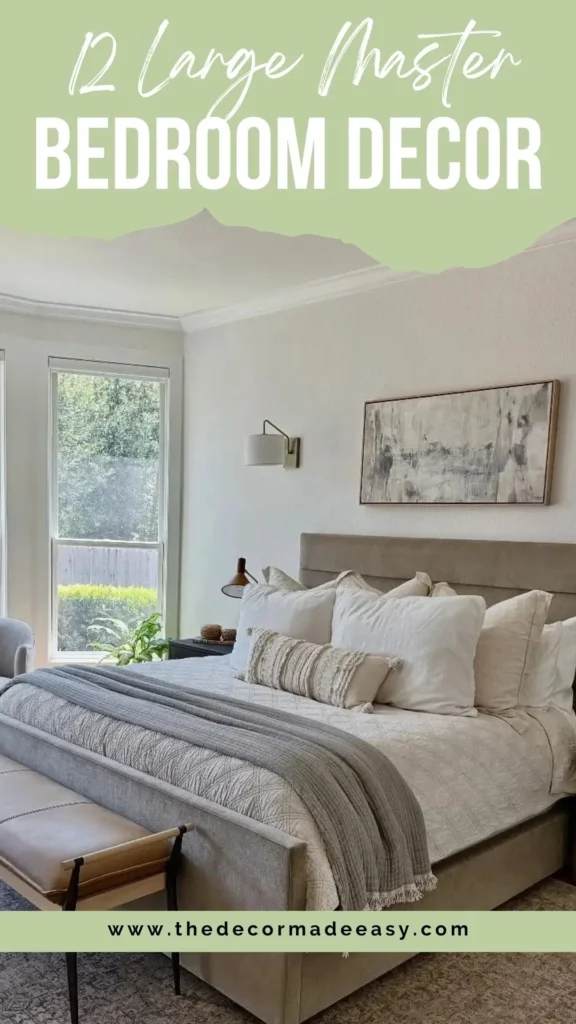
12. Casual Scandinavian Warmth: Gray Upholstery and Brass Sconces
This is honestly the room I’d most want to wake up in every morning, which feels like a valid measure of success. It prioritizes comfort and calm over drama, using a gray channel-tufted upholstered bed with a matching gray footbench as its low-key anchor. No statement walls, no bold color moments. Just a room that feels genuinely good to be in.
Natural light floods in from a bay window on the left, where two rounded gray barrel chairs and a slim marble-top side table create an intimate reading nook. Sheer white window dressing lets the garden view become part of the room’s decor. On the headboard wall, brass swing-arm wall sconces bracket a horizontal abstract artwork in gray and taupe, a painting that feels like a landscape viewed through fog. Beautiful without being showy.
The black nightstand provides contrast without demanding attention. A small brass arc lamp adds warmth. The layered bedding in white, cream, and textured gray creates that lived-in softness that looks effortless but actually takes some styling thought. A layered rug in faded indigo blue and taupe grounds the arrangement and adds the one moment of cooler color in an otherwise warm neutral room.
What this room gets completely right is scale. Every piece of furniture is correctly proportioned to the room. The chairs don’t get swallowed by the space. The bed fills its zone without crowding. The bay window becomes a defined area rather than wasted square footage.
Getting scale right is the single most important factor in large master bedroom decor. It’s the decision that separates rooms that feel intentional from rooms that feel unfinished.
What Every One of These Rooms Gets Right
Looking across all twelve examples, a few truths show up every single time regardless of style.
Every successful large master bedroom defines clear zones. A sleeping area, a sitting area, a lighting plan. They never treat the whole space as one giant undifferentiated room. Every one of them also has a strong focal point, whether that’s a chandelier, a feature wall, or one statement piece of furniture.
None of them were finished in a single shopping trip. The rooms that feel most complete are layered. They mix materials, combine old and new textures, and include at least one element that doesn’t obviously belong to the dominant style. That small tension is what gives a room actual personality instead of a showroom feel.
The best starting point for any of these directions? Look at your ceiling height and natural light first. Those two fixed factors should drive almost every other decision: the scale of your furniture, the depth of your color choices, whether pendant or table lighting serves you better. Work with the room you actually have, and everything else becomes considerably easier to figure out.
Go on then. Your large master bedroom isn’t going to decorate itself.