12 Black Tile Bathroom Ideas That Will Change Your Mind

Let’s address the elephant in the room. Black tile has a serious image problem. Everyone assumes it turns bathrooms into depressing caves. Too dark. Too cramped. Too hard to clean. Shows every water spot.
Here’s the thing though. Most people making those claims have never actually seen black tile done well. I’ve spent way too much time obsessing over bathroom designs, and I pulled together 12 real examples that range from dramatic showstoppers to quietly elegant spaces.
Each one handles the dark tile challenge differently, and honestly, some of these might completely change how you think about your next bathroom renovation.
Vertical Black Stacked Tile with Brass Fixtures and a Round Mirror
You know that feeling when every single element in a room just earns its spot? This bathroom absolutely nails it.
The wall features vertically stacked black rectangular tiles with crisp white grout lines running horizontally. These tiles are narrow and elongated, creating this graphic pattern that looks almost like woven textile up close but reads as clean architecture from across the room.
What makes it work is the brass. Every metal element matches perfectly. The pendant light, round mirror frame, wall-mounted faucet, hook hardware. All warm antique brass. Against that cool dark tile, those gold tones genuinely glow rather than clash.
The pendant light deserves its own moment. It’s a funnel-shaped brass fixture with an exposed Edison bulb that hangs center frame and casts this gorgeous pool of warm light onto the white undermount sink below.
Light-washed oak cabinetry sits beneath a thick white stone countertop, and that warm wood grain creates direct contrast against the black backdrop. A small white ceramic vase with dried globe thistle and a dark glass soap dispenser on a brass tray complete the look. These styling choices feel personal, not staged.
Pro tip: Commit to one metal finish throughout. Mixing brass with chrome or black hardware here would absolutely break the spell. And that white grout? It’s doing serious work. It gives your eye a visual rhythm and keeps the wall from feeling flat or oppressive.
Black Geometric Mosaic Shower Tile with Gold Veining
This one genuinely surprised me.
The shower wall features large-format black mosaic tiles with an irregular, almost cracked-earth pattern filled with thick gold metallic grout lines. The effect lands somewhere between kintsugi pottery and stained glass. Dark fragments connected by luminous gold lines. It’s kind of stunning.
The rest of the bathroom stays deliberately understated so the shower wall can have its moment. White large-format subway tiles cover the main walls. White quartz countertop sits on a dark espresso-toned vanity. Matte charcoal square floor tiles in a standard grid. None of these elements compete. They frame the shower like a stage set frames a performance.
Brass hardware ties everything together. The shower frame, shelf brackets, vanity pulls, and towel bar all match that warm brass tone echoing the gold grout lines. This continuity between grout color and fixtures is the kind of detail that separates thoughtfully designed bathrooms from ones that just happened.
One important note: this tile style works best as a dedicated accent wall or shower surround. The pattern is visually busy, and surrounding yourself with it on every surface would be exhausting. One bold wall plus calm neutrals keeps the energy balanced.
Black and White Checkerboard Floor with Jungle Wallpaper
Some bathrooms commit to a theme. Some hide from one. This powder room commits. Hard.
The floor features classic black and white checkerboard using square tiles set at a 45-degree diagonal. Roughly 6×6 inches, executed cleanly with consistent grout lines. Above the wainscoting (painted deep charcoal gray with crisp white molding) the upper walls and ceiling are covered in dramatic jungle botanical wallpaper featuring tigers, leopards, and dense tropical foliage in teal, navy, and forest green.
A white marble-look vessel sink with heavy gray veining sits on a charcoal floating vanity with a tall slender brass faucet. A cast-iron radiator in dark pewter finish anchors the back wall. The door hardware is a textured black cylindrical pull that suits the moody atmosphere perfectly.
Here’s the genuinely clever part: that gray wainscoting acts as a transition layer. Without it, the checkerboard floor and wild wallpaper would fight each other constantly. The charcoal panels create a buffer zone. Dark enough to belong to both elements, neutral enough to let each breathe.
FYI, checkerboard tile has survived every design trend of the last century. It’s not going anywhere. Pairing it with bold wallpaper rather than plain paint is the update that makes this version feel current rather than retro.
Also Read: Stop Ignoring Your Shower: 12 Real-Life Shower Tile Ideas That Actually Work
Black Slate Herringbone Floor Tile with Oak Vanity
The floor tells the entire story in this bathroom. And it’s a good one.
Dark charcoal slate tiles (roughly 4×12 inches) run in a herringbone pattern across the entire floor. The pattern flows cleanly under the toilet and alongside the oak vanity without any awkward cuts. This tells you the tile setter planned the layout carefully before the first piece went down. The natural variation in slate surface (some pieces almost black, others showing subtle dark gray striations) gives the floor genuine depth that ceramic imitations rarely achieve.
The rest of the room stays almost entirely white and neutral. Clean off-white walls, standard white porcelain toilet, oak vanity with warm honey tone, matte black bar pulls, and white countertop. Zero drama above waist height, which is exactly the right call when your floor does something this interesting.
What I find useful about this example is how it proves black tile bathroom ideas don’t require black on the walls. A dark floor with light walls creates a grounded, anchored feeling. Heavier at the base, lighter as you move upward. This mirrors how we experience the natural world. It’s a psychologically comfortable arrangement, even if most people couldn’t articulate why it feels right.
The herringbone layout adds motion to what might otherwise be a static surface. Your eye follows the pattern’s zigzag rhythm across the floor, making even compact bathrooms feel more dynamic and larger than they are.
All-Black Subway Tile Shower with Matte Black Hardware
This version is for people who don’t want to negotiate with color. At all.
The shower features floor-to-ceiling classic subway tile (3×6 inch bricks) in deep matte charcoal-black glaze, laid in standard running bond offset pattern. Light gray grout lines create just enough contrast to define tile edges without lightening the overall effect. Every fixture is matte black. Rain showerhead, diverter valve, body spray controls, niche shelving. Even the door frame is black steel.
A built-in niche on the left wall holds a glass bottle and candle. This surprisingly effective styling detail adds warmth to an otherwise monochrome space. That flickering candle and amber light visible through the glass create the kind of hotel-bathroom atmosphere most people associate with expensive spa stays.
The gray grout is why this design holds up rather than feels oppressive. Black-on-black grout would make individual tile shapes disappear and the wall would read as a flat dark surface. The visible tile grid keeps texture alive and prevents the space from feeling like a void.
Quick note: matte black subway tile works particularly well in bathrooms with good natural light or strong artificial lighting. Matte surfaces absorb light rather than reflecting it, so the tile color reads truest in well-lit conditions. In a dim bathroom, invest in quality lighting before committing to this palette.
Black Floor Tile with Pink Walls and an Arched Entry
Not every black tile bathroom idea needs to lean dark and moody. This one proves it.
You enter through a graceful white-painted archway (an architectural detail that frames the space as a destination rather than a utility room). Inside, the floor uses large-format dark charcoal square tiles in a simple grid layout. The walls feature pale bubblegum-pink square tiles from floor to approximately halfway up, with white plaster above. Black-framed windows and a black-framed mirror anchor the room’s edges and tie back to the dark floor.
A white freestanding soaking tub sits center stage. A classic white pedestal sink occupies one corner. The black furniture piece in the foreground (a low dresser with black hardware) clearly came from another room rather than purchased as bathroom furniture. This gives the whole space an effortless, collected quality.
The pink-and-black combination has deep design roots. It references everything from 1950s Hollywood glamour to contemporary maximalism without feeling derivative. White architectural elements (the arch, plaster walls, trim) prevent the color combination from becoming too candy-sweet or too grim.
If you’re renovating a home with original pink tile that everyone tells you to rip out: don’t. Lean into it. Pair it with a dark floor, black frames, and black furniture. What looked dated suddenly looks deliberate.
Also Read: Steal the Look: 10 Blue Tile Designs That Put Basic Bathrooms to Shame
Dark Green Subway Tile with Black Slate Floor and Brass Throughout
Technically this bathroom features deep hunter green subway tile rather than black. But the floor is large-format dark slate in near-black charcoal, and the design principles here apply directly to black tile bathroom ideas.
Main walls use white subway tile in traditional running bond pattern. A horizontal band of deep forest green glossy subway tile runs at mid-wall height, wrapping around the room and creating a clear dividing line between white field above and dark slate floor below. A wood-effect porcelain panel covers the shower area, adding warmth and grain texture without real timber maintenance concerns in a wet zone.
Everything metal is brass. Floor-mounted freestanding tub filler with cross handles, pedestal sink with dual brass taps, brass-framed mirror, and what appears to be a brass heated towel rail. The white freestanding rectangular tub positioned center-left anchors the composition beautifully.
What I find instructive here is the banding technique. Running a horizontal stripe of dark tile at chair-rail height is traditional but effective. It mirrors architectural wainscoting, introduces dark elements without overwhelming the room, and creates a natural visual anchor. You could execute this exact idea with black tile rather than green and achieve an equally strong result.
Large-Format Black Marble-Look Tile with Patterned Cement Floor
This bathroom balances competing tensions and manages it confidently. Large dark slabs on walls against intricate patterned tile on the floor.
Oversized black tiles with pronounced marble-like veining in light gray and white cover the walls. The veining is organic and sweeping (not tight geometric lines) with loose, gestural strokes closer to Nero Marquina stone. Tiles run floor-to-ceiling on two walls and wrap the shower enclosure, creating a seamless dark envelope.
Against that, the floor uses white cement encaustic tiles with bold geometric pattern (interlocking circles and polygons in black and white). The contrast between quiet grandeur of large wall tiles and busy graphic floor could easily go wrong. But the black-and-white palette unifies both surfaces.
A light oak floating vanity with white quartz countertop sits against the black-tiled wall. Matte black hardware throughout keeps metal finishes consistent. A single brass wall sconce beside the mirror introduces warmth and prevents the space from feeling too stark.
The lesson here is scale contrast. When you use two patterned surfaces together, make them different in scale. Large-format wall tile with small-pattern floor tile (or vice versa) creates interest without chaos. Matching scales on two surfaces creates visual competition that neither wins.
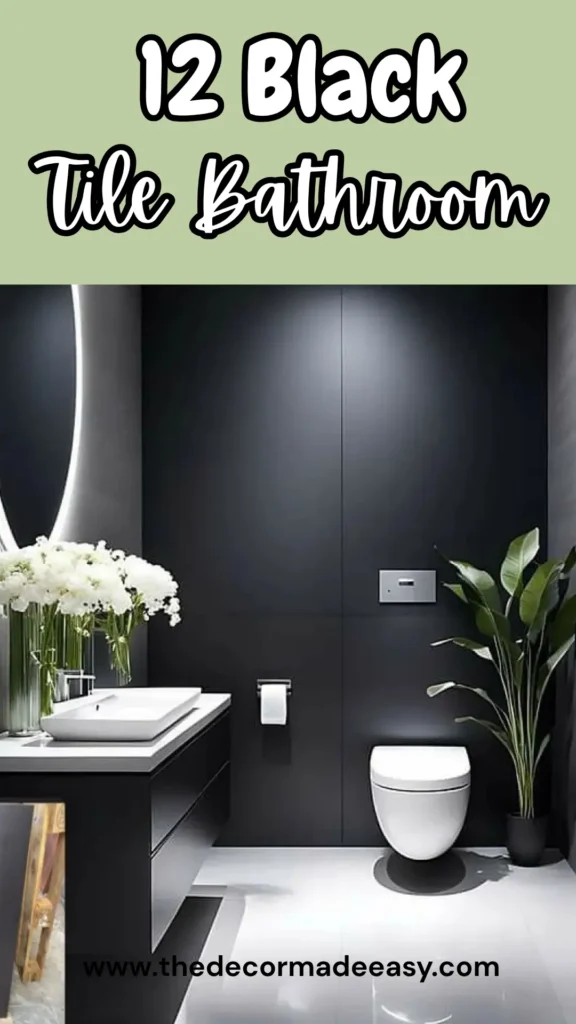
Minimalist Black and White Bathroom with Backlit Oval Mirror
Pure restraint. Executed with confidence.
This bathroom uses matte black large-format tiles on walls (a brushed or textured surface with subtle variation) alongside polished white floor tile creating deliberate floor-to-ceiling contrast. A wall-mounted white ceramic vessel sink sits on a thin floating black vanity shelf. A wall-mounted toilet in white occupies the right side. A single tall green architectural plant (bird of paradise or similar) stands floor height beside the toilet, its deep green leaves the only warm color in the room.
The focal point is the large backlit oval LED mirror above the sink. Its soft halo of white light creates diffused glow wrapping the mirror in atmospheric warmth. A vase of white flowers on the sink counter echoes the white-on-black theme while softening the space considerably.
This design works because every element points in the same direction: fewer things, carefully placed. The lack of visible storage above counter, hidden toilet cistern, and wall-mounted fixtures each remove visual noise and let tile carry the aesthetic weight.
IMO, this is the style I’d recommend for someone nervous about dark tile. Black remains on walls where it creates drama, but white floor and white fixtures prevent the room from ever feeling enclosed or small. Recessed ceiling spotlights handle ambient lighting efficiently.
Also Read: 12 Subway Tile Bathroom Ideas That’ll Make You Rethink Everything
Half-Wall Black Glazed Square Tile with Freestanding Tub and Art
This design keeps pulling me back, probably because it treats the bathroom as a proper room rather than a utilitarian space.
The lower half of walls (from floor to approximately mid-wall height, roughly traditional wainscoting proportion) features glossy black square tiles, maybe 4×4 inches. Visible variation in the glaze gives each tile slightly different reflective quality. The surface appears almost wet with deep reflective quality. Above the tile line, walls are painted clean off-white. Multiple operable windows set into the tile-height zone have white frames emerging directly from the black tile field.
A cream oval freestanding soaking tub sits center stage, its smooth white surface contrasting directly with dark tiled backdrop. A small rustic wooden stool sits beside it (simple, practical, warm in tone). A small framed portrait painting hangs above the tub on the white plaster section, an unexpected decorative choice that anchors the space and gives it lived-in personality.
Large-format neutral gray porcelain floor tiles provide visual bridge between black-tiled lower walls and white upper walls.
The half-wall tile approach is genuinely practical. You get visual drama of black tile where it makes impact (grounding the room and framing architectural elements) without committing to full-height dark tile on every surface. It’s easier to maintain visually and easier to light effectively.
Vertical Ribbed Black Tile Shower in a White Bathroom
This one demonstrates how a single design decision applied consistently in one zone can define an entire bathroom without taking it over.
The bathroom is primarily white: white walls, white wall-hung toilet, white oval mirror, white vessel sink, neutral gray stone-effect floor tile. The floating vanity unit is matte black with black marble-veined countertop. Into this calm white space, the shower enclosure introduces deeply textured surface: floor-to-ceiling narrow vertical ribbed black tiles, roughly 2 inches wide and 12 inches tall, running in stacked vertical pattern.
The ribbed surface is the detail worth examining. Each tile has a three-dimensional corrugated face (like miniature folded surface) that catches light differently depending on angle. When lit from above, ridges cast tiny vertical shadows animating the wall surface. When viewed straight on, tile reads almost solid. Visual interest comes from movement rather than color. Sophisticated approach.
Brass hardware provides warmth: shower head, shower controls, and brass towel rail. A trailing ivy plant sits in a shelf niche within the shower, a fresh green note against black ribbed backdrop.
Textured tile in darker color always beats flat tile. The texture justifies the dark color choice by proving the surface offers something up close (detail, dimension, craftsmanship) rather than simply absorbing light.
Dual Organic-Shaped Backlit Mirrors with Black Stone Vanity
This is the most forward-looking design in this collection. Also the one most likely to divide opinion.
The bathroom features neutral concrete-effect plaster on main walls, white polished floor tile, and recessed glass-enclosed wet room on the right side clad in large-format highly polished black stone tiles. The stone has dramatic veined surface, and high polish creates reflections making the space feel like it continues indefinitely.
The vanity is a floating wood-grain cabinet with long matte black double basin countertop. Two asymmetric organic-form mirrors (shapes somewhere between pebble and teardrop) are backlit with warm amber-white halo. The backlighting gives mirrors sculptural quality. They read as objects rather than simply reflective surfaces.
Matte black wall-mounted faucets serve each sink basin. A diffuser, black soap pump, and reed diffuser sticks accessorize the vanity surface with restraint.
What this design illustrates is that black tile doesn’t have to be the only dark element in a bathroom. When tile, vanity counter, fixtures, and architectural element framing all work in the same dark palette, the room achieves coherent depth that single-element approaches rarely reach. It’s high-commitment design, but the result is a bathroom that looks designed by a single thoughtful hand rather than assembled from a catalog.
Choosing the Right Black Tile Approach for Your Bathroom
After looking at these 12 examples, clear patterns emerge. Here’s a practical breakdown to help you think through which approach might suit your situation:
Vertical stacked tile + brass
- Best for: Powder rooms, guest baths
- Key element: Consistent metal finish
- Difficulty: Medium
Geometric mosaic accent wall
- Best for: Shower feature wall
- Key element: Neutral surroundings
- Difficulty: Medium
Checkerboard floor + bold wallpaper
- Best for: Small powder rooms
- Key element: Gray transition wainscoting
- Difficulty: Easy
Herringbone slate floor
- Best for: Any bathroom size
- Key element: Quality tile setter
- Difficulty: Medium
All-black subway shower
- Best for: Master bath showers
- Key element: Good lighting plan
- Difficulty: Easy
Pink + black contrast
- Best for: Vintage or eclectic homes
- Key element: Black architectural frames
- Difficulty: Easy
Half-wall tile with freestanding tub
- Best for: Full bathrooms with height
- Key element: Clean tile-to-plaster line
- Difficulty: Medium
Large-format marble-look
- Best for: Larger bathrooms
- Key element: Scale contrast with floor
- Difficulty: Advanced
Minimalist black walls + white floor
- Best for: Modern streamlined spaces
- Key element: Recessed lighting
- Difficulty: Advanced
Ribbed textured tile in shower
- Best for: Contemporary bathrooms
- Key element: High-output shower lighting
- Difficulty: Medium
Dual organic mirror + black stone
- Best for: Master suites
- Key element: Professional installation
- Difficulty: Advanced
A few consistent truths run through every successful example here:
- Metal finish consistency matters. Pick one and commit
- Lighting is non-negotiable. Dark tile absorbs light, so you need to replace what it takes
- One statement surface almost always beats wrapping every wall in dark tile, especially in smaller bathrooms
What Actually Makes Black Tile Bathrooms Work
The fear about black tile isn’t unfounded. It can make a space feel like a mood-lit hotel bar when you’re just trying to brush your teeth at 6am. But the bathrooms in this collection suggest the fear is mostly about execution rather than the tile itself.
Every successful example here managed the darkness through contrast. A white floor, light vanity, warm metallic fixtures, natural wood, abundant light. These elements don’t fight black tile. They complete it. The black functions as a backdrop that makes everything else look more considered, more deliberate, more worth noticing.
The other thing these examples share is commitment. Half-measures tend to produce muddled results in bathroom design. The checkerboard powder room went all-in on personality. The all-black shower leaned fully into the aesthetic. The marble-look tile bathroom chose its patterned floor confidently. Uncertainty is a design choice too, just not usually a flattering one.
Whatever version of these black tile bathroom ideas appeals to you, the next step is the same: pick your surface, choose your contrast element, and commit. The results are genuinely worth it.
So what do you think? Ready to take the plunge on black tile, or still need some convincing? Either way, at least now you know it doesn’t have to look like a cave.