A Dining Room Without a Chandelier Is Just a Room with a Table (Let’s Fix That)

Let’s be honest. A dining room without a chandelier is just… a room with a table in it. Not exactly the vibe you’re going for when you want guests to walk in and immediately feel something. The right chandelier doesn’t just light up your dinner. It sets the whole mood, tells your style story, and honestly? It kind of makes everything else in the room look better too.
I went deep on real-world examples to bring you ten chandelier dining room ideas that actually inspire action. Not Pinterest boards you save and forget. Real setups with real lessons you can steal. Some of these genuinely surprised me, and a couple of them changed how I think about scale and proportion entirely.
1. Tiered Crystal Drama Over a Dark Lacquer Table
This combo sounds like it could go sideways fast. A tiered crystal chandelier over a deep espresso lacquer table? Bold move. But here’s the thing. It never goes wrong.
The setup features a two-tier drum-shaped chandelier in aged brass, dripping with cascading crystal strands that throw warm amber light all over the room. Underneath sits a high-gloss ebony table with a mirror-like finish, eight boucle chairs in a warm greige tone, and a distressed vintage rug tying it all together.
Why does this work so well? Contrast. The dark table and warm walls give the crystal chandelier an actual backdrop to shine against. Most people hang a chandelier and then wonder why it doesn’t feel magical. Nine times out of ten, there’s just nothing around it creating contrast. Here, the light becomes the event.
A few tips if you want to recreate this:
- Commit to a darker table finish. Deep walnut or espresso works just as well as full black.
- Go for at least two tiers on the crystal chandelier.
- Use warm white bulbs at 2700K or lower. Cool lighting in a crystal fixture looks clinical. Warm lighting looks elegant. Huge difference.
- Hang it so the bottom sits 32 to 34 inches above the tabletop. That proportion matters more than most people realize.
2. Dual Cylinder Glass-Rod Chandeliers Over a Rose Quartz Dining Table
This one stopped me cold the moment I saw it. Two large cylindrical chandeliers with vertical clear glass rods suspended inside chrome drum frames hang in tandem over an oval dining table with a rose quartz and pink marble surface. IMO, this is one of the boldest pairings in the entire list.
The glass rods inside each fixture catch light from different angles, creating a subtle prismatic effect without the fussiness of traditional crystal. The marble table brings warmth through its veining in rose, terracotta, and dusty mauve tones. Gold wire dining chairs with taupe velvet cushions finish the look, and an organic macramé wall sculpture ties the whole thing together beautifully.
Here’s the key design move: using two chandeliers instead of one over a long table. A single large fixture often creates one bright zone with relative darkness on both ends. Two matching fixtures solve that problem and create a visual rhythm that feels completely intentional.
The marble also does something clever here. It introduces color through stone rather than paint or textiles, so the pink and gold tones feel surprising and sophisticated instead of overwhelming.
Budget tip: Clear acrylic or glass rod cylinder pendant lights are widely available at accessible price points. The effect still translates even when the materials are more modest.
3. Twin Candle-Arm Crystal Chandeliers Beneath a Coffered Ceiling
Some rooms are built to impress before a single piece of furniture arrives. This is one of them.
The ceiling features a custom coffered design with interlocking circular moldings and inset mirrors at the intersections, all painted in a soft silver-grey. Two identical crystal candle-arm chandeliers hang from it, each with multiple tiers of curved arms ending in crystal-trimmed candleholders. The chairs below are upholstered in a silver-grey damask that echoes the ceiling geometry, and the espresso dining table grounds the otherwise light palette.
What really stands out here is the ceiling as a design partner. Most people treat the ceiling like a passive surface. This room treats it like a fifth wall with a job to do. The coffered design with inset mirrors reflects the crystal chandeliers from above, creating a doubling effect that makes the whole space feel larger and more layered.
When pairing two chandeliers with an architectural ceiling, scale is everything. Each fixture here runs about 24 to 28 inches in diameter. Large enough to read from a distance, but not so large that it fights with the ceiling’s own visual complexity.
Pro tip: If your ceiling already has significant architectural detail, choose a cleaner, simpler chandelier. A more restrained fixture will actually feel stronger in that context, not weaker.
Also Read: The New Standard: 12 Real-World Luxury Dining Rooms That Refuse to Settle
4. Capiz Shell and Brass Branch Chandelier in a Transitional Dining Room
Not every chandelier dining room idea needs to announce itself from across the room. This one is quieter, more personal, and because of that, it actually stays with you longer.
The chandelier here is an organic branch-style fixture with a brass armature supporting cascading layers of white capiz shells. The shells catch light gently and move with the air, creating a soft, almost aquatic shimmer. Below sits a warm cherry-wood oval table with traditional carved pedestal legs, surrounded by neutral linen chairs in an oatmeal tone. A cobalt blue lacquered sideboard with brass diamond hardware provides the one strong color note in an otherwise calm palette.
The capiz shell chandelier earns its place because it introduces texture and movement without hard edges. Traditional furniture can sometimes feel static. An organic chandelier loosens things up without abandoning the formality completely.
That blue sideboard is working just as hard as the chandelier, by the way. It provides the contrast that keeps everything from reading as too beige. If you go with a capiz or natural-material chandelier in a traditional dining room, find one strong accent piece in a bold color that the rest of the room earns against.
Bonus: Capiz shell chandeliers are among the most forgiving fixtures to scale. Because the material is light and translucent, a larger diameter fixture doesn’t feel heavy or imposing. Great option when you want impact without visual weight.
5. Classic Crystal Chandelier in a Dark, Moody Dining Room
A traditional crystal chandelier in a dark room is the oldest trick in the book. And it still works because it is fundamentally correct.
This dining room commits fully to a deep teal-grey wall color that runs from floor to crown molding. A carved white marble fireplace provides the only relief. A polished mahogany oval table sits at the center, surrounded by klismos-style chairs in teal velvet. A dramatic dried botanical arrangement tops the table. And above it all hangs a classic crystal chandelier with curving arms, teardrop prisms, and a central stem of cut glass.
The chandelier here functions like a light source in a painting. It creates the sense that the room glows from within rather than just being lit from above. Against dark walls, every crystal facet has genuine contrast to work with, so the fixture actually sparkles instead of just existing.
What separates this from “just a dark room with a chandelier” is the deliberateness of every surrounding choice. The Persian rug adds warmth at floor level. The antique hutch introduces honey-toned wood in the background. Nothing is accidental.
Key takeaway: If you go dark walls, choose a chandelier with a high crystal count. Sparse crystal arrangements disappear against dark backgrounds. You need density to get that full sparkle effect.
6. Empire-Style Crystal Chandelier in an All-Blue French Country Dining Room
This is the most cohesive single-color dining space I’ve come across, and the chandelier choice is what makes the whole palette breathe instead of suffocate.
Powder blue painted cabinetry lines both walls, displaying porcelain plates and silver tea service pieces. The wallpaper behind features a tonal blue-on-white botanical medallion pattern. The dining chairs are pale blue-grey linen with white lacquered frames and geometric cutout details. And at the center hangs an empire-style chandelier with a white-painted metal frame, crystal bead swags, and gold leaf crown finials at the top.
The white-framed chandelier is the critical decision in this room. Chrome would have made it cold. Brass would have competed with the cabinet hardware. The white-painted frame threads the needle perfectly. It reads as part of the blue-and-white palette rather than introducing a whole new metallic tone into the mix.
Empire-style chandeliers are genuinely underused in contemporary dining rooms, and that’s a shame. Their hourglass or cone-shaped crystal arrangements are more versatile than people think. They work in traditional rooms, transitional spaces, and even certain modern settings when the finish is updated.
If you want to pull this off at home: commit to the palette fully. Halfway-blue is worse than all-blue. Pick your shade, go all in, and let the chandelier be the one element that gently breaks the rule.
Also Read: From Pinterest Rabbit Holes to Reality: 13 Round Table Dining Room Ideas for Real Homes
7. Crystal Tent Chandelier Beneath a Hand-Painted Dome Ceiling
There are rooms designed for daily living and rooms designed as experiences. This one is unambiguously the second kind. And yes, it’s as dramatic as it sounds.
A vaulted dome ceiling has been hand-painted with sweeping white molding curves on a cream background, creating a tent-like canopy overhead. The surrounding walls feature a lush floor-to-ceiling tropical mural with palm trees, birds of paradise, and foliage in deep greens, warm golds, and sky blues. From the apex of the dome hangs a crystal chandelier with cut crystal arms radiating outward like sea creature spines and a tiered crystal body below.
The chandelier here is actually restrained relative to the room, and that restraint is exactly right. When a ceiling and walls are this elaborate, the chandelier’s job shifts from focal point to punctuation mark. It needs to feel worthy of the space without trying to compete with it.
This example teaches something really useful about chandeliers and context. Most chandelier dining room ideas treat the fixture as the star of the show. This room proves a chandelier can play a supporting role and still be extraordinary.
If your room is simpler: this is also a compelling argument for wall murals as a backdrop strategy. A significant mural completely changes what a chandelier needs to do in a space.
8. Grand Crystal Globe Chandelier with a Maximalist Painted Ceiling
Fair warning: this room is a lot. And it works completely. Don’t fight it.
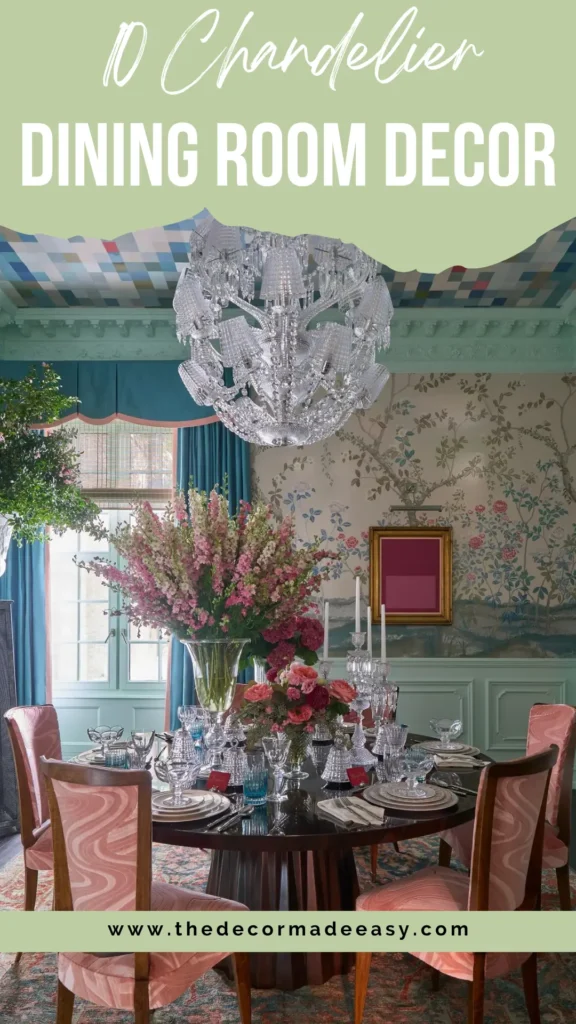
The ceiling is painted in a geometric diamond-grid pattern using soft pink, mint green, sage, dusty blue, and ivory. From the center hangs a massive spherical crystal chandelier, the kind most associated with the Baccarat brand, densely packed with cut crystal elements that refract light in every direction. Below sits a round dark-stained table surrounded by chairs in a wavy-stripe pink fabric. The walls feature hand-painted chinoiserie panels with flowering branches and birds. Deep teal window trim and pink-bordered drapes hold the structure together.
What this room demonstrates is that maximalism requires discipline, not restraint. There are at least six strong design decisions happening simultaneously. The ceiling pattern, the chinoiserie walls, the crystal chandelier, the pink chairs, the teal trim, and the round table. Every single one goes all the way. None of them hedge. And that’s exactly why they achieve a strange harmony together.
The moment one element tries to be neutral in a room like this, the whole thing becomes incoherent. Full commitment or don’t bother.
On chandelier scale: a visually dense room like this needs a fixture with real mass. Something with enough presence to register as a design element rather than disappearing into the visual noise above. A smaller chandelier would have been swallowed whole here.
9. Tiered Crystal Drum Chandelier in a Soft Blue and Gold Dining Nook
Smaller dining rooms tend to make the mistake of choosing small chandeliers. This example argues convincingly for the exact opposite approach, and I’m here for it.
The space is a compact dining nook with pale blue-grey walls, white wainscoting, and dark hardwood floors. A round pedestal table in warm driftwood tones holds white hydrangeas, brass candlestick lamps, and gold accents. Mixed seating surrounds it, with light blue upholstered chairs and a tan linen banquette. A gallery wall of black-and-white photographs in gold frames hangs behind.
The chandelier is a tiered drum style with cascading crystal drops in multiple lengths set in a brass frame with warm amber bulbs. It’s substantial, probably 24 inches across, in a room where the table itself is around 48 inches in diameter. That roughly 1:2 ratio between chandelier diameter and table diameter is a benchmark many designers follow, and you can see immediately why it works.
The brass finish connects the chandelier to the gallery wall frames, the candlestick lamps, and the gold accents throughout. This is one of the most practical chandelier dining room ideas in this whole list. Choose a fixture finish that echoes two or three other metallic elements already in the room. Simple to execute, reliably effective every single time.
Bottom line: treating a dining nook with the same seriousness as a full formal dining room, including a properly scaled chandelier, transforms a small corner into one of the most inviting spots in your entire home.
Also Read: 12 Steal-Worthy Ideas for Your Modern Farmhouse Dining Room
10. Glass Bubble Chandelier in a Modern Farmhouse Dining Room
The biggest shift in chandelier dining room ideas recently has been away from crystal and toward sculptural glass forms that prioritize shape over sparkle. This example makes the strongest possible case for that direction.
The room is a bright, clean modern farmhouse space with white vertical shiplap walls, large black-framed windows overlooking a garden, and wide-plank light oak floors. A square dark-stained dining table sits at the center, surrounded by eight barrel-back chairs in cream boucle with brass foot caps. Two fiddle-leaf fig trees add organic height in the corners. The chandelier is a clustered glass bubble design, dozens of mouth-blown clear glass spheres in varying sizes suspended from a brass frame in a loose oval arrangement.
During the day it reads as sculpture. At night it creates a warm, diffused glow that feels genuinely cozy. Crystal would have felt out of place here. A drum pendant would have felt too corporate. The bubble form hits the sweet spot, enough sculptural interest to feel intentional without disrupting the room’s quiet confidence.
If you’re working in a modern, transitional, or Scandinavian-influenced space and struggling to find a chandelier that fits without feeling forced, glass bubble or globe cluster designs are absolutely worth serious consideration. They photograph beautifully, age well, and avoid the trend vulnerability that comes with more stylistically specific fixtures.
Quick Comparison: Which Chandelier Style Fits Your Room?
| Style | Best For | Scale Tip | Finish Direction |
|---|---|---|---|
| Tiered crystal drum | Traditional or transitional rooms | 1/2 to 2/3 of table width | Brass or chrome |
| Dual cylinder glass-rod | Contemporary or artisan spaces | Match two fixtures to table length | Chrome or satin nickel |
| Crystal candle-arm | Formal dining, architectural ceilings | One per 4 to 6 feet of table length | Chrome or crystal |
| Capiz shell or organic | Transitional or coastal rooms | Go larger than you think | Brass or natural |
| Crystal globe or sphere | Maximalist or jewel-box rooms | Fill at least 30% of ceiling zone | Clear crystal |
| Glass bubble cluster | Modern farmhouse or Scandi rooms | Oval or round shape to mirror table | Antique brass |
| Empire-style crystal | French country, traditional | Cone width should match chair count | White, gold, or silver |
The Real Takeaway: Stop Playing It Safe
Every single room in this list has a chandelier that was chosen with full understanding of the space around it. The wall color, the table finish, the ceiling height, the furniture scale, and the emotional vibe of the room. That relationship between fixture and setting is the actual secret.
The biggest mistake people make when choosing a dining room chandelier is treating it as an independent purchase rather than a relational one. A chandelier that looks stunning in a showroom might do absolutely nothing in your actual space, or worse, actively compete with what’s already there.
Before you buy, ask yourself what your chandelier will be working alongside. Then use these quick rules:
- Scale down in material complexity when the room is already visually rich.
- Scale up in size when the room is simple and needs a focal point.
- Let the metal finish echo at least one other metallic element already present in the room.
- Resist the urge to play it safe with something small and cheap. A properly scaled chandelier in a real material almost always does more for a dining room than the cautious choice ever will.
The range of what actually works is genuinely wide, from crystal and capiz shell to globe clusters and candle arms, from moody and dark to bright and airy. All ten of these examples succeed for the same reason. Someone made a real decision instead of a safe one.
Your turn. What’s your dining room working with right now? Pick the style that fits your space and go all in. You’ll thank yourself later.