15 Dining Room Lighting Ideas That’ll Make You Never Eat Under Boring Lights Again

Let me tell you something nobody talks about enough: bad dining room lighting ruins perfectly good meals. Not in a dramatic, “I can’t eat this” way, but in a subtle, “why does this room feel like a waiting area” kind of way. The fixture hanging above your dining table does way more than light up your food. It sets the mood, anchors the room, and honestly tells guests something about your taste before anyone even sits down.
I’ve spent a ridiculous amount of time studying real dining spaces (yes, this is what I do for fun, apparently), and I’ve pulled together 15 lighting ideas that each make a genuinely strong case for how a dining room should feel.
These aren’t Pinterest fantasies or showroom setups. These are real rooms making real choices, and every single one of them teaches you something you can actually use.
Whether you’re starting fresh or just trying to figure out why your current setup feels weirdly off, you’re in the right place.
1. Brass Multi-Pendant Cluster Over a Natural Oak Table
This is the combo that makes you stop and go, “Okay, that just works,” before you’ve even figured out why.
The fixture is a cluster of three dome-shaped brass pendants with frosted glass globes, hanging at slightly different heights from a single ceiling canopy. Against a white coffered ceiling, the warm brass tones feel intentional and relaxed at the same time. It doesn’t scream “look at me” but it definitely holds the room together.
Here’s why it actually works: brass sits right in the middle of warm and cool. It bridges the light oak dining table below and the dark walnut barn-style sliding door behind it without competing with either. The cognac leather chairs reinforce that warm, mid-century-meets-natural vibe the fixture starts.
The pendant cluster hangs low enough to feel cozy over the table but doesn’t block anyone’s view across it. The golden rule here is to hang dining pendants so the bottom of the fixture sits 30 to 36 inches above the tabletop. This setup nails that, and it shows.
Takeaway: pair a brass cluster pendant with a simple, natural-material table. Let the fixture do the decorative heavy lifting. The table just needs to show up and be itself.
2. Linear Rectangular Pendant in an Exposed Industrial Setting
Here’s something worth knowing: a classic rectangular drum pendant doesn’t have to scream “traditional.” It all depends on what you put around it.
This setup features a substantial rectangular pendant with a cream linen shade and brushed nickel frame, hanging over a large rectangular stone-look dining table. The room itself has exposed white brick walls, painted industrial pipe runs across the ceiling, and structural columns that give the whole space a real loft-in-the-city energy. Track lighting overhead handles the ambient fill while the pendant does its job as the visual centerpiece.
What surprises me about this space is how well the fixture holds its own. That exposed ceiling infrastructure could have made anything hanging below it look like an afterthought. Instead, the rectangular pendant mirrors the proportions of the table directly beneath it, creating a strong visual column from table surface up to the ceiling. That’s a principle worth tattooing on your brain.
The heathered grey upholstered dining chairs add softness that the hard brick and stone surfaces desperately need. A decorative metalwork wall sculpture adds a finished touch without introducing any extra light source.
Takeaway: if your room has strong architectural character, choose a clean, well-proportioned pendant that complements it rather than fights it. This approach ages beautifully.
3. Twin Crystal Chandeliers Under an Ornate Coffered Ceiling
Some rooms want drama. This one doesn’t just want it, it demands it.
Two matching crystal chandeliers, each with multiple candelabra-style arms and clear hand-blown glass elements, hang in tandem over an extended dark ebony dining table. The decision to use two fixtures instead of one is architecturally smart. The ceiling above features elaborate cofferwork with circular medallion details and embedded mirror tiles, making the ceiling itself basically another decorative surface. One chandelier would have looked completely lost up there.
The grey palette throughout, including silver-grey velvet chairs with damask upholstery, slate-grey geometric wallpaper, and charcoal drapery, gives the room a monochromatic restraint that stops the two chandeliers from tipping into full chaos. Everything is working in the same direction.
The real showstopper? The circular coffering with mirrored insets reflects the crystal chandeliers from above, creating a third visual layer. Most people think about lighting from the top down. This room also lights itself from above looking up. That’s genuinely clever design.
Takeaway: if you have a long rectangular dining table with serious ceiling height, two chandeliers can solve the scale problem and prevent that awkward “one big fixture floating above too much empty table” situation.
Also Read: The “No-Fake-Fruit” Guide to 12 Kitchen & Dining Looks You’ll Actually Love
4. Cascading Capiz Shell Chandelier with Layered Ambient Sources
This is the kind of chandelier that makes guests stop mid-sentence to stare at the ceiling. Take that as the compliment it is.
The fixture is an organic capiz shell chandelier with layered translucent elements draping downward from a brass-twig armature, kind of like a weeping willow frozen in a beautiful moment. The scale is generous, the kind that would overwhelm a smaller room, but next to tall windows and a substantial antique-style mahogany table, it lands perfectly.
What pushes this beyond “interesting focal point” is the layered lighting approach. Wall sconces provide secondary ambient fill. Tall brass candlesticks on a cobalt blue sideboard add warm, low-level accent light. The result is a room with real depth of illumination. You’re not asking one source to do everything, which is honestly one of the biggest mistakes people make in dining rooms.
FYI, that cobalt blue sideboard with its arch-cutout paneling and diamond-shaped gold hardware is doing serious work here. That specific blue-grey against the warm wood tones creates a visual triangle that the lighting reinforces beautifully.
Takeaway: for traditional or transitional dining rooms, think beyond the single pendant. A statement chandelier paired with two or three secondary sources creates a space that feels genuinely considered, not just lit.
5. Brass Multi-Arm Chandelier Over a Round Table in a Transitional Dining Room
Round tables have a specific lighting problem that people underestimate: they don’t have a long axis, so a rectangular fixture always looks like it’s pointing the wrong way. This room solves that neatly.
The chandelier is a multi-arm brass fixture with individual white cone shades, each arm extending outward and slightly upward from a central sphere before curving back down to hold a small conical shade with a warm-white bulb underneath. The overall silhouette is round and expansive, which directly echoes the circular table below. Simple solution, incredibly effective.
Against a crisp white coffered ceiling and cream walls with detailed crown molding, the brass fixture ties directly to the light wood and brass hardware on the built-in cabinetry in the adjoining room. That kind of material through-line, using one metal finish consistently across multiple elements, is what makes rooms feel designed rather than just assembled.
The blue velvet dining chairs with a contrasting textured back panel bring the only real pop of saturated color. A deep cobalt blue vase on the table reinforces that choice. Everything else stays warm and neutral, letting the fixture hold center stage.
Takeaway: when choosing a chandelier for a round dining table, match the fixture’s overall profile to the table’s shape. A circular or starburst-style chandelier almost always feels more resolved than a rectangular one awkwardly positioned sideways.
6. Sculptural Brass Branch Chandelier in a Modern Transitional Space
This chandelier earns its place as a focal point the right way: through genuine sculptural quality, not just size.
The fixture features curved brass arms that branch organically from a central point, each ending in a small white cylinder shade. The branching form suggests something from nature, which makes it feel warmer than a purely geometric fixture while still reading as completely contemporary. Against clean white walls and a high ceiling, the brass catches natural light pouring through large black-framed floor-to-ceiling windows.
The surrounding design choices support the chandelier’s personality rather than competing with it. Deep slate-blue patterned drapery panels create rich contrast against the white walls. The oval walnut dining table and natural linen chairs keep the base of the room calm and unfussy. Two vintage oil paintings in gilded frames add a note of history that prevents the room from feeling too fresh-out-of-the-box.
Here’s something I genuinely love about this setup: the fixture works differently depending on the time of day. In daylight, the brass catches natural light and the shades look crisp white. At night, the warm-white bulbs create an intimate, cozy atmosphere. It’s basically a two-in-one fixture: daytime sculpture, nighttime mood setter.
Takeaway: for rooms mixing modern and traditional elements, an organic-form chandelier in a traditional finish at a contemporary scale is usually a reliable bridge.
Also Read: Stop Pinning, Start Living: 12 Real-Life Boho Dining Rooms That Actually Work
7. Tiered Crystal Drum Chandelier in a Blue-and-Gold Glam Dining Room
This room commits to glamour fully, zero apologies, and honestly? Respect.
The chandelier is a tiered drum-style fixture with multiple rings of rectangular crystal prisms arranged in descending tiers, all set in a champagne gold frame. It’s substantial but not ridiculous. The downward sparkle from the crystals amplifies the candlelight and lamp glow coming from the multiple table sources below. Two matching table lamps with pleated cream shades flank a centerpiece of white hydrangeas, creating a deliberately styled tableau at table level.
The soft blue palette, including ice-blue dining chairs, deep sapphire curtain panels with embroidered border trim, and blue-and-white ceramic accents, would read cold without the warmth the gold hardware and layered lighting introduces. The crystal chandelier acts as the room’s warmth engine, catching and distributing the warm-toned light from all those table sources and amplifying the effect across the room.
A gallery wall of black-and-white photography in gold frames adds personal warmth that no expensive furniture alone could replicate. This is a room that tells you something real about the person living in it.
Takeaway: for formal dining rooms leaning into a decorated aesthetic, matching your chandelier’s metal finish to your other hardware (curtain rods, picture frames, candlestick holders) creates coherence that feels intentional without feeling matchy-matchy.
8. Polished Nickel Five-Arm Chandelier in a Bright Casual Space
Not every dining room needs to be formal. This one makes that case with refreshing confidence.
The fixture is a five-arm chandelier in polished nickel, each arm splaying outward from a central hub and ending in a white cylindrical shade. The form is clean and geometric, almost like a simplified starfish, and the polished finish catches the abundant natural light flooding in from large black-framed windows and sliding glass doors surrounding the space. Recessed can lights overhead handle the additional ambient fill.
The round natural oak table sits on a modest pedestal base, surrounded by fully upholstered white dining chairs. The entire color palette, which includes white, natural oak, polished nickel, and white sheer curtains, stays consistently light and airy. A large potted olive tree in a white cylindrical planter brings one organic note without disrupting the intentional brightness.
What I find smart about this setup is the acknowledgment that the view is the real star. The black-framed windows frame a backyard pool scene, and the design correctly treats every interior element as a supporting character. The polished nickel fixture reflects outdoor light rather than competing with it.
Takeaway: for bright, view-forward dining spaces, polished nickel or chrome fixtures often outperform brass or black. They participate in the light rather than absorbing it.
9. Cascading Smoked Glass Globe Pendant Cluster Over a Live-Edge Slab Table
IMO, this is the combination that earns the most genuine admiration from people who don’t even consider themselves interested in interior design. And I think I know exactly why.
The live-edge walnut slab dining table with its preserved natural edges and visible grain, mounted on a geometric cross-base, is already a statement. Putting the wrong fixture above it would either create unnecessary competition or completely disappear. The right call here was a cascading cluster of smoked glass globe pendants, each housing a warm Edison-style filament bulb, suspended at varying heights from a central canopy in a staggered arrangement.
The effect is atmospheric in a way that formal fixtures rarely pull off. The smoked glass diffuses the filament glow just enough to create warmth without harsh bright points, and the cluster’s density creates a visual mass that holds its own above a substantial table. At the right dimmer setting, this setup produces exactly the kind of light that makes food look good and faces look warm. That’s the dream, right?
Gold candlestick holders and a shallow decorative bowl continue the warm metallic theme at table level. The surrounding space, with its barn-style black door, light walls, and clean white upholstered chairs, provides a neutral backdrop that lets the table-and-fixture combination command full attention.
Takeaway: if you’re working with a statement table, find a fixture that complements the table’s material character rather than simply centering above it and calling it a day.
Also Read: Stop Falling for Pinterest Lies: 10 Farmhouse Dining Rooms You Can Actually Recreate
10. Recessed Lighting as the Primary Source in an Open-Plan Space
Every dining room lighting article covers chandeliers and pendants. Far fewer acknowledge that recessed lighting, done well, is its own completely valid answer.
This open-plan space uses recessed can lighting as its primary ceiling source in the dining zone. No pendant, no chandelier, just a clean grid of recessed fixtures that keep the ceiling visually uncluttered and let the room’s architecture do the talking. Crown molding, painted columns, dark hardwood floors, and crisp white walls form the visual vocabulary. A dark walnut dining table and warm grey upholstered chairs keep things grounded.
The sideboard styling carries a lot of visual weight here: an abstract canvas in gold and cream, white ceramic decorative objects, and a clear glass vase with dried botanicals all add layers of interest that compensate for the intentional restraint overhead.
What makes recessed lighting actually work in a dining room rather than feeling like someone just forgot to add a real fixture is strategic placement. Fixtures should wash the table surface and avoid pointing directly into seated guests’ eyes. And here’s a non-negotiable: pair recessed lights with a dimmer switch. The difference between recessed lighting at full blast and at 40% is literally the difference between a cafeteria and an actual dining experience.
Takeaway: for open-plan homes where a pendant might feel visually disconnected from the broader space, a thoughtful recessed lighting setup with supplemental sources at lower levels can produce a genuinely cohesive, comfortable result.
11. Sculptural Globe Constellation Pendant Over a Marble Oval Table
This room knows exactly what it wants to be, and the lighting fixture is the clearest expression of that intention.
The pendant installation above this oval marble-top dining table features multiple white frosted globe lights suspended from thin brass rods extending outward from circular brass frames. The overall form suggests a scientific model of an atom or a hanging mobile, something that feels artistic and purposeful at the same time. Each globe casts soft, diffused light, creating a constellation effect above the table that is both decorative and genuinely functional.
The table itself, an oval marble top with dramatically veined black-and-white surfaces on a sculptural dark pedestal, is a strong enough piece that it needed an equally assertive fixture to match. Around the table sit wraparound leather bucket chairs in a deep sage green, a color choice that shows real confidence. Polished marble floors, sandy plaster-textured walls, and a large circular bronze wall clock complete a room that commits fully to contemporary luxury.
A detail I love here: the shadow cast by the circular fixture frames on the back wall isn’t accidental. It functions as a secondary decorative element, essentially a lighting installation that shifts and changes throughout the day as natural light moves through the room.
Takeaway: for contemporary dining rooms with strong architectural and material choices, a sculptural pendant installation that can visually compete with the furniture is usually the right call.
12. Crystal Rain Pendant with Wall Sconce Layers in a Designed Interior
Here’s a space that demonstrates something genuinely worth understanding: in great residential design, lighting has become architecture.
The ceiling pendant is a dramatic crystal waterfall-style fixture, with long transparent crystal strands hanging from a dark rectangular ceiling panel and creating a curtain of light descending toward the table. The effect is theatrical and precise at the same time. On either side of a botanical-patterned accent wall panel, cylindrical gold tube wall sconces add secondary light at mid-height. Recessed can lights at the perimeter handle the ambient fill. Three layers of light, all working together. That’s not an accident.
The dining table keeps its vocabulary simple: a rectangular form with gold legs and a light wood top so the furniture doesn’t compete with the ceiling drama. Cream upholstered chairs with black legs provide contrast without pulling focus. The botanical wallpaper panel centered between grey vertical stripe panels gives the room a focused accent wall that the downward waterfall form of the fixture reinforces perfectly.
What this interior gets absolutely right is treating wall sconces as architectural elements, not afterthoughts. Installed at the right height and in the right proportion, they establish a visual rhythm around the room’s perimeter that pendant-only dining rooms almost never achieve.
Takeaway: don’t just think vertically. A pendant plus well-placed wall sconces creates a layered, dimensional lighting scheme that makes rooms feel designed from every angle.
13. Large Double-Tiered Drum Pendant in a High-Contrast Black and White Dining Room
Bold design decisions tend to travel in packs. Commit to one strong choice and the others tend to follow naturally. This room is a textbook example.
The ceiling is papered in a swirling black-and-white abstract pattern, which, let’s be honest, would be completely overwhelming without the right fixture to anchor the space below it. The choice here, a large double-tiered drum pendant in white fabric with a brass chain and canopy, is exactly the right counterweight. Its circular, three-dimensional form creates a visual pause between the pattern above and the clean horizontal of the dining table below. The white fabric shade glows softly from within, giving the eye a calm center point to naturally return to.
Black walls, white wainscoting, and a bleached oak dining table flanked by black-stained rattan-back chairs complete the high-contrast framework. This whole scheme would fall apart with a different fixture. Something too fussy, too sparkly, or too small would get completely swallowed by that ceiling pattern. This drum pendant has the mass and simplicity to hold its own, and that’s exactly what the room needed.
The emerald green ceramic vessels on the table provide the one color pop in an otherwise binary palette. They work precisely because the matte drum fixture isn’t competing for that accent role.
Takeaway: when you’re working with a visually active ceiling treatment, choose a clean, substantial, simply shaped pendant. Give the eye somewhere to rest.
14. Gold Sputnik-Style Globe Branch Chandelier Over a White Rectangular Table
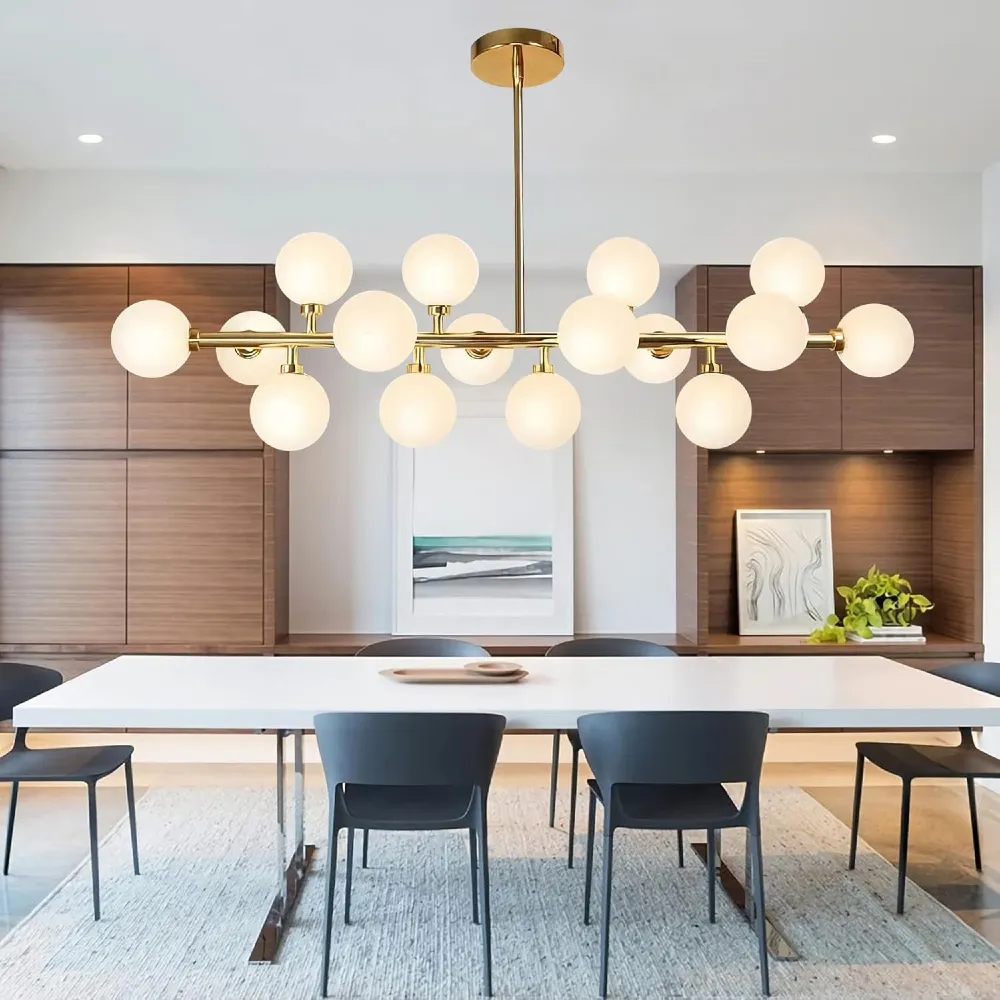
Few fixtures communicate “contemporary” as efficiently as a well-executed globe chandelier. This example shows you exactly why.
The chandelier is a long horizontal bar in polished gold with multiple branching arms at different heights, each ending in a frosted white glass globe. Around 16 globes total create a generous spread of soft, even light across the white rectangular dining table below. The frosted glass diffuses the light source completely, producing a glow rather than a harsh point, which is almost always more flattering in a dining setting.
The room surrounding it stays deliberately calm: walnut-paneled cabinetry filling the back wall, a white marble-like dining surface, and slate grey upholstered chairs with a clean silhouette. The warm gold of the fixture against the cool grey-and-white palette creates a visual focal point without any competition from additional decorative elements.
Here’s what I find really instructive about this setup: the chandelier’s horizontal spread is comparable to the table’s length, which means the light distribution is essentially even from end to end. No dark corners, no glaring bright center, just a consistent wash of warm globe light across the entire surface. That’s thoughtful fixture sizing in action.
Takeaway: for contemporary open-plan dining spaces, a globe branch chandelier in gold or brass integrates well across a wide range of design styles and doesn’t become visually dated as quickly as more trend-specific fixtures.
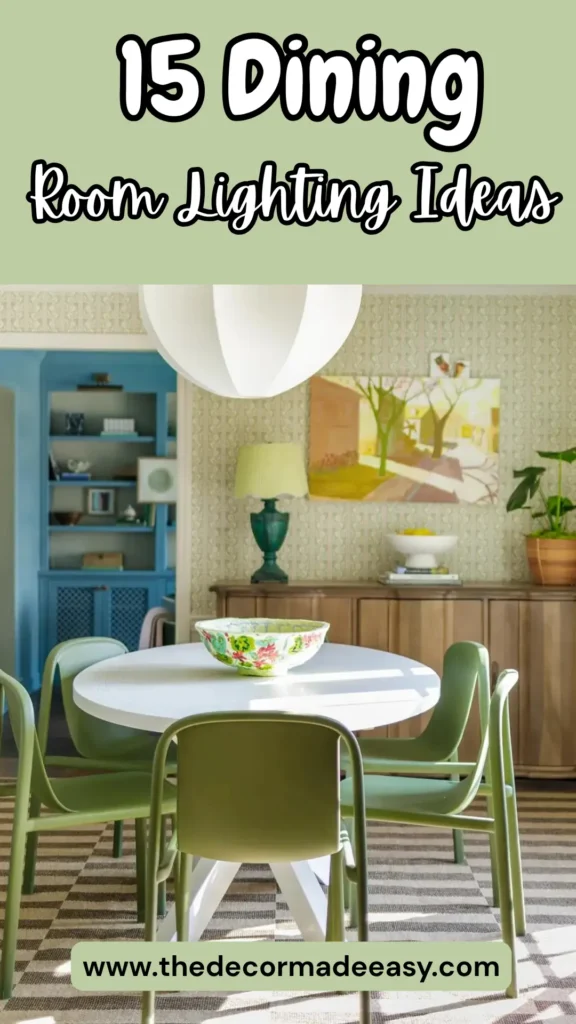
15. White Globe Semi-Flush Pendant in a Colorful Eclectic Dining Space
This last one is my personal favorite, not because it’s the most formal or the most impressive-looking, but because it makes a really strong case for restraint in a room that could have easily gone overboard.
The fixture is a large white semi-flush globe pendant, a single clean spherical form in matte white fabric with a small brass ceiling canopy. That’s it. Nothing else going on up there. And in a room this colorful and layered, that restraint is exactly right.
Sage green painted chairs surround a white circular pedestal table with a vivid floral ceramic bowl as the centerpiece. The walls carry a small-scale cream-and-green botanical wallpaper pattern. A striped natural fiber rug anchors the floor. Through a doorway, a turquoise blue bookcase is visible. On the sideboard, a green ceramic lamp, a colorful oil painting, trailing plants in terracotta pots, and stacked books all contribute to an atmosphere of collected, layered personality.
And into all of that, one modest white globe pendant hangs overhead and asks for absolutely nothing. It provides light, it gives the eye a clean circle to land on, and then it steps aside. A more elaborate fixture would have tipped this room from vibrant and charming into chaotic and exhausting.
Takeaway: sometimes the best lighting choice is the one that quietly does its job and lets everything else shine. That’s not settling. That’s smart design.
Quick Reference: Which Dining Room Lighting Style Is Right for You?
| Lighting Style | Best Room Type | Mood Created | Difficulty |
|---|---|---|---|
| Brass multi-pendant cluster | Mid-century, transitional | Warm, intimate | Medium |
| Linear drum pendant | Contemporary, industrial | Clean, modern | Easy |
| Crystal chandelier | Traditional, formal | Elegant, dramatic | Advanced |
| Capiz/shell chandelier | Eclectic, coastal | Layered, warm | Medium |
| Multi-arm brass chandelier | Transitional, traditional | Refined, classic | Medium |
| Sculptural branch chandelier | Contemporary, eclectic | Artistic, organic | Medium |
| Tiered crystal drum | Glam, maximalist | Glamorous, festive | Advanced |
| Polished nickel chandelier | Casual, contemporary | Bright, airy | Easy |
| Smoked glass globe cluster | Industrial, rustic | Atmospheric, warm | Advanced |
| Recessed-only approach | Open-plan, minimalist | Clean, flexible | Medium |
| Globe constellation mobile | Contemporary luxury | Sculptural, artistic | Advanced |
| Crystal rain/waterfall pendant | Contemporary, dramatic | Theatrical, designed | Advanced |
| Double-tier drum pendant | Bold, eclectic | Calm focal point | Medium |
| Gold globe branch sputnik | Contemporary, transitional | Modern, generous | Medium |
| Large white globe semi-flush | Colorful, eclectic | Simple, grounded | Easy |
The Real Lessons These 15 Spaces Teach You
Looking across all 15 of these dining room lighting ideas, one thing stands out clearly: the fixture is almost never the whole answer. It’s always a conversation between ceiling height, table shape, room palette, and the atmosphere you actually want to live inside every day.
What strikes me most is how often the simplest choice in a complex room, or the boldest choice in a simple room, turns out to be exactly right. The single white globe pendant in the colorful eclectic space. The twin crystal chandeliers under the elaborate coffered ceiling. Neither of those choices would work in the other room, and that specificity is entirely the point.
Scale is probably the single most common mistake in dining room lighting. A fixture that’s too small reads as an afterthought no matter how beautiful it is. Before you buy anything, measure your table, note your ceiling height, and seriously consider a fixture that feels slightly large in the store. It will almost certainly feel right once it’s actually hanging in the room.
The second big lesson: stop treating lighting as a single decision. Nearly every compelling space here layers at least two sources: a primary pendant or chandelier paired with sconces, table lamps, or recessed fills. That layering is what separates rooms that look great in photos from rooms that actually feel great to sit in, which, let’s be honest, matters a whole lot more.
Good dining room lighting is the thing your guests never consciously notice but always respond to. Get it right, and the room does the rest of the work for you.
So, which of these 15 styles are you secretly already obsessed with? Pick one, commit to it, and give your dining room the lighting it genuinely deserves.