12 Bathroom Floor Tile Ideas That Prove the Floor is the Foundation, Not an Afterthought

Let’s be honest. You’ve probably spent three weeks comparing seventeen shades of white paint, debated cabinet knobs like your life depended on it, and then picked the first neutral tile you saw for your bathroom floor.
I get it. Floors feel like an afterthought. They’re down there, you walk on them, whatever.
But here’s the thing: your bathroom floor is actually the secret sauce of the whole room. It’s the one element that touches everything visually, sets the entire mood, and is basically impossible to change once it’s in. So maybe, just maybe, it deserves more than a five minute decision at the tile store?
I’ve gathered 12 real bathroom floors from actual homes (not those suspiciously perfect showroom setups) that prove exactly why the floor deserves your attention. Whether you’re working with a tiny powder room or a sprawling primary bath, at least one of these will make you want to rip up whatever boring beige situation you’ve currently got going on.
Dark Charcoal Slate in a Herringbone Pattern
The first thing that grabbed me about this floor wasn’t the color. It was the movement. These dark charcoal slate tiles sit in a herringbone pattern, and honestly? A standard grid layout could never deliver this kind of visual energy.
The tiles look to be roughly 4×12 inches, laid at opposing 45 degree angles to create that classic zigzag running diagonally across the floor. It’s giving architectural interest without trying too hard.
What really makes this bathroom floor tile idea work is the contrast. The deep matte gray tones of the slate (with subtle natural veining) play beautifully against the warm honey oak vanity and white walls. Without that floor, this room would be… fine. Pleasant, but forgettable. With it? Suddenly the oak cabinetry looks intentional, and even the brass floor vent feels like a deliberate design choice.
The Real Talk on Installation
Herringbone is technically more demanding than a straight grid. Every single tile needs precise angle cuts at the perimeter. If you’re hiring someone, expect to pay about 20 to 30 percent more than you would for a standard brick pattern.
Is it worth it? IMO, absolutely. Herringbone is probably the single most effective way to add architectural interest to a bathroom floor without spending more on the actual tile material.
One tip: see how the thin gray grout lines here are nearly invisible? That’s intentional. When you want the pattern to read as one cohesive surface rather than individual pieces, match your grout color closely to your tile.
Bold Black and White Checkerboard in a Maximalist Powder Room
There’s a specific type of confidence required to commit fully to a room like this, and I respect it deeply.
The floor features classic square checkerboard tiles in sharp black and cream white. This pattern has been around for literally centuries, and somehow it still manages to feel fresh when you put it in the right context.
And oh boy, is the context here wild. We’re talking dark charcoal wainscoting, jungle print wallpaper covered in tigers and leopards, a marble vessel sink with dramatic gray veining, and brass hardware everywhere. By any rational calculation, this should be a complete disaster.
Instead? The checkerboard floor acts as a visual anchor that holds the entire room together. The graphic simplicity balances out the maximalist wallpaper above. Two bold elements somehow negotiating a truce.
Why This Works in Small Spaces
Here’s a useful lesson for anyone nervous about bold bathroom floor tile ideas in a compact space: small rooms can actually handle big patterns better than large ones. There’s limited floor visible at any given time, so a checkerboard in a powder room reads as exciting rather than overwhelming.
The classic black and white combo also works across basically any design era. Victorian, mid century, contemporary… you’ve got flexibility.
Practical note: go with a matte finish for those white tiles if you don’t want to see every single footprint and water spot. Glossy white checkerboard in a wet environment will demand your attention daily. And nobody needs that kind of relationship with their floor.
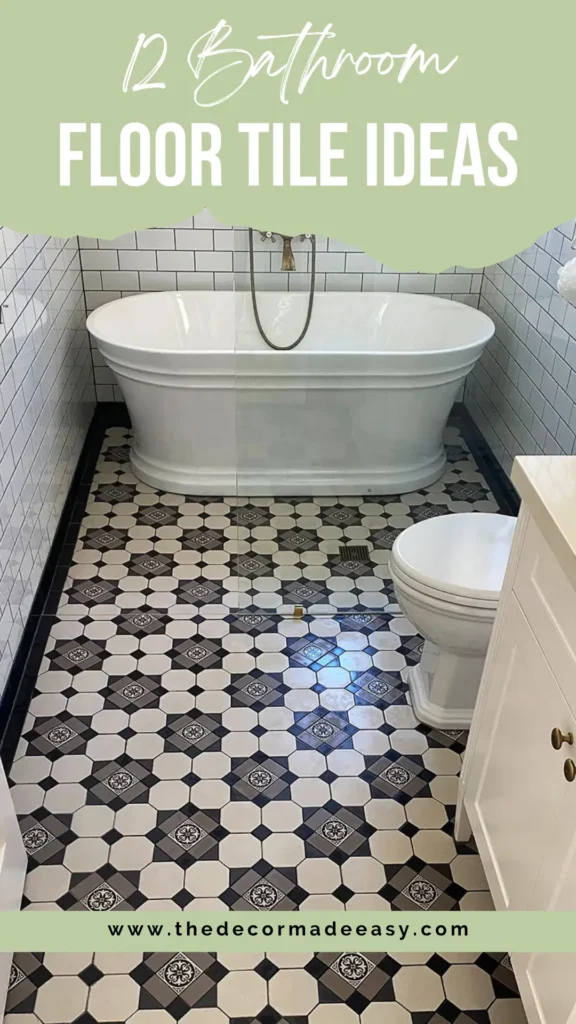
Victorian Octagon and Dot Mosaic with Decorative Inserts
This floor is genuinely something special.
Large white octagonal tiles sit in the classic Victorian pattern, with smaller black diamond “dot” tiles filling the gaps between each octagon. Standard stuff so far. What elevates this beyond your typical octagon and dot situation is the introduction of intricate decorative insert tiles. These small square accent pieces feature a detailed floral motif in black, gray, and white.
The inserts appear at regular intervals throughout the field, turning what could be a straightforward historical reference into something way more layered and luxurious. A dark blue border tile frames the entire floor, which I appreciate. It defines the space with a clear boundary rather than letting the pattern just run off the edge.
Installation Reality Check
Victorian mosaic flooring like this rewards patience during installation. The tiles typically come on mesh backing sheets for manageable handling, but achieving consistent grout lines across a complex multi element pattern requires experience.
My honest take: if you’re attempting this for a full bathroom, budget for a professional. For a smaller space like an entryway or powder room, it becomes more financially feasible as a DIY project.
The moral of this floor? Historical tile patterns became historical because they work. They’ve just been waiting for someone brave enough to commit to them fully.
Also Read: 10 Real-Life Green Tile Bathrooms That Prove This Color Works in Every Space
Spanish Style Encaustic Cement Tile with Daisy Motifs
This one caught me completely off guard.
The floor features hand painted encaustic cement tiles covered in a dense geometric lattice pattern in sage green and cream, punctuated by bold daisy like florals in red, coral, and golden yellow. It reads like something you’d find in a 1920s California mission revival home. Given the arched glass shower door and black framed windows, that appears to be exactly the vibe they’re going for.
What makes this floor work is the smart layering. The sage green wall paint picks up the dominant color from the tile. The ceiling stays bright white. White subway tiles in the shower provide breathing room from all that pattern. White vanity cabinets keep the floor as the clear star of the show.
One element gets to shine. Everything else plays a supporting role. This is how you do it.
The Maintenance Truth About Cement Tiles
Encaustic cement tiles need specific care that standard ceramic tiles don’t require:
- Seal before installation (non negotiable)
- Re seal periodically as the porous cement surface will absorb stains otherwise
- Water, soap, and cleaning products can dull an unsealed surface over time
Here’s the upside though: cement tiles develop a beautiful patina with age that actually improves their character. No glazed ceramic can replicate that lived in quality. If you’re drawn to this artisan, handcrafted look, the maintenance trade off is absolutely worth it.
Just commit to the sealing schedule from day one. Future you will be grateful.
Cream Hexagon Mosaic with Black Diamond Border
Another Tessellated Tile Factory installation, and this one demonstrates something important that many people overlook: the border is just as important as the field.
The main floor surface consists of small ivory hexagonal mosaic tiles. Classic, timeless, widely available. Nothing groundbreaking on its own. What transforms this from ordinary to exceptional is the precise black geometric border running along the perimeter and shower threshold. The border pattern alternates between diamond shapes and triangular elements in black against the cream field, creating a frame that gives the entire floor intentional structure.
Scattered throughout the field are small black hexagonal flower motifs appearing at irregular intervals, like a printed textile.
The Budget Friendly Secret
This approach of combining a simple field tile with a more elaborate border is actually one of the most cost effective ways to achieve a high end mosaic floor. Think about it:
- Most of the floor uses inexpensive hexagonal penny tile
- Only the border requires the more complex patterning
- The visual effect reads as entirely cohesive and custom
One thing to watch for: the border width needs to be proportionally calibrated to your space. A border that’s too thick feels like a picture frame that overwhelms the artwork. In this bathroom, they nailed the proportions.
Geometric Green and Cream Marble Triangle Tile
The floor here uses triangular marble tiles in two distinct tones: a warm cream beige marble and a deep forest green marble with natural white veining. The pieces sit in a scattered, non repeating geometric pattern with white grout lines defining each triangle.
From a distance, the effect reads as abstract and almost painterly. Up close, you see individual stone pieces with their natural variation in tone and veining.
What I find genuinely compelling about this choice is how it interacts with the rest of the room. The warm sandy beige wall paint picks up the lighter marble tone. The teal towels echo the green marble. Even the brass faucet hardware feels connected to the warm undertones in the stone.
Nothing in this bathroom was chosen in isolation. The floor clearly came first, and every other element was selected to complement it.
A Principle Worth Stealing
Choose your floor tile before you commit to fixtures, paint, or cabinetry. The floor is the hardest thing to change and the element that touches everything visually. Start there, work outward.
Natural marble in two complementary colors also has the advantage of providing inherent variation. No two slabs are identical, which means your floor will never look machine made or repetitive.
The maintenance requirements of natural marble are real (sealing, pH neutral cleaners, avoiding acid), but for a design this distinctive, I’d argue the trade off is worth accepting.
Also Read: Stop Picking Random Tiles: 15 Real-Life Bathroom Designs That Actually Work
Warm Red Brick Style Mosaic Tiles
Red clay brick tiles in a bathroom floor sounds questionable until you see it executed well. Honestly, I was skeptical.
These small rectangular tiles (about the size of traditional brick but scaled to a mosaic format) cover the floor in a warm, earthy terracotta red that leans toward aged clay rather than anything modern or polished.
The rest of the bathroom clearly understood the assignment. Gray green painted cabinetry with rounded wooden drawer knobs, a marble countertop, large scale mirror, and yellow green cafe curtains all contribute to an aesthetic that feels genuinely lived in and personal. Not assembled from a showroom catalog. The brick tile floor reads as the kind of detail you’d find in an older European home, which is entirely the point.
Getting the Look Right
One nuance worth noting: these tiles appear to have a textured, slightly uneven surface rather than a perfectly flat finish. That texture provides grip (important for a wet floor) and also contributes to the handmade quality of the look.
If you want to try brick style tile in your bathroom:
- Avoid anything too glossy or too uniform
- The charm comes from the imperfection
- Look for unglazed terracotta, quarry tile, or brick effect ceramic with a matte or satin finish
- Pair with similarly warm, organic materials like wood, stone, and aged brass
- Skip anything too clinical or contemporary because it will fight the inherent warmth
Navy Blue Moroccan Star and Compass Pattern
Bold. Graphic. Completely confident.
The floor features a deep navy blue and white Moroccan inspired cement tile pattern (the classic star and compass or alhambra design) covering the entire bathroom floor and continuing into the shower. The pattern is dense and intricate, with multiple interlocking geometric shapes that catch the eye without resolving into a simple repeating block.
Against the all white everything else (white walls, white floating vanity, white toilet, chrome fixtures) the navy floor has enormous presence.
This is exactly how you use a bold patterned tile. Strip everything else back to a clean, simple palette and let the floor carry the room. The textured vertical tile in the shower provides subtle interest without competing.
What You Need to Know Before Ordering
Moroccan style cement tiles have genuinely broad appeal right now because they bridge multiple design vocabularies. They feel global and eclectic without being kitschy, geometric without being cold, and traditional without feeling dated.
Important purchasing tip: the colors in cement encaustic tiles can vary batch to batch. Order 10 to 15 percent more than you need from the same production run. Mixing tiles from different batches on the same floor can create visible color variation that no amount of grout artistry will disguise. Don’t learn this the hard way.
Natural Slate Mosaic Floor Tiles
This bathroom floor uses natural slate tiles in a rough cut square format, installed in a slightly irregular grid with wider grout lines that emphasize each stone’s individuality. The colors shift across the surface (cool blue gray, warm taupe, hints of rust and charcoal) because natural slate carries significant color variation within a single quarry batch.
The floor connects directly to the broader material story in this bathroom. Dramatic multicolored marble slabs cover the back wall. Teak wood lines the door frame. Everything is textured, organic, and slightly raw. This isn’t a bathroom designed to feel clinical. It’s designed to feel like stepping into a landscape.
Practical Advantages of Slate
Slate flooring requires the same sealing considerations as other natural stone, but it offers one advantage that ceramic cannot: the naturally cleft surface provides excellent grip underfoot, even when wet. That matters in a bathroom.
The rough texture does make cleaning slightly more demanding (think grout brush rather than simple mop), but slate durability is exceptional. Well maintained slate floors routinely last decades without significant wear.
If you’re drawn to this earthy, grounded aesthetic: prioritize honed or natural cleft slate over any variety with a polished finish. Polished slate in a bathroom becomes dangerously slippery when wet. Nobody wants their bathroom to double as an ice rink.
Also Read: 12 Pink Bedroom Decor Ideas for When You Want “Serene Sanctuary,” Not “Dollhouse”
Multi Tone Stone Mosaic Squares
This floor is a study in controlled complexity.
Hundreds of small square stone mosaic tiles (perhaps 1.5 to 2 inches each) cover the bathroom floor in a palette that includes cream, warm sand, terracotta brown, dusty rose, olive green, slate gray, and near black. The distribution appears random, but the overall impression reads as cohesive because all the tones share a similar earthy, mineral quality.
What makes this work is the tonal range. There’s enough variety to create visual texture without any single color dominating so strongly that it fragments the surface. The stone materials appear to include marble, travertine, and possibly slate. Natural stones whose color variation is inherent rather than applied.
Installation Tips
Mosaic tile sheets like this typically come pre mounted on mesh backing, which makes installation more manageable than placing individual pieces.
The main challenge: maintaining consistent grout line width when multiple mesh sheets meet, particularly at corners and thresholds. A good tile setter will score and trim the mesh backing carefully at transitions rather than forcing sheets to butt together awkwardly.
Pro move: request corner mock ups from your installer before work begins. Better to catch issues early than have regrets later.
Dusty Blue and Cream Encaustic Pattern Tile
The pattern on this floor is sometimes called a Moorish ogee or arabesque design. It’s an interlocking curved motif that creates a feeling of continuous flowing movement across the surface. The colors are soft: dusty steel blue, warm off white cream, and a pale gray taupe in the secondary elements.
The result is ornate without being heavy. That’s not an easy balance to achieve.
The bathroom itself stays deliberately calm: white walls, white wainscoting panels, white toilet, and a dark wood cabinet that grounds the base of the room. Navy vertical tiles in the bath surround provide a visual connection upward from the floor pattern’s blue tones.
Color Threading Strategy
This kind of color threading (picking up a floor color in a wall element to tie the room together) is worth intentionally incorporating into any bathroom design. It makes everything feel considered rather than random.
One reason patterned encaustic tiles perform well in bathrooms: their hand finished surfaces hide water spots and minor soap residue far better than glossy ceramics. The matte, slightly textured surface also provides better traction.
FYI, these tiles come in both authentic cement encaustic and glazed ceramic versions. The ceramic versions are easier to maintain but lose some tactile warmth. For a high traffic family bathroom, ceramic is a reasonable compromise. For a primary suite or powder room with lighter use, the authentic cement tile is worth the additional care.
Custom Figurative Mosaic with Synchronized Swimmers
This is the most surprising floor in this entire collection, and I mean that as a complete compliment.
The ivory field consists of tiny square mosaic tiles (perhaps 1 inch each) laid in a uniform grid. A precise black and terracotta border frames the perimeter. And scattered across the ivory field are hand crafted mosaic figures of synchronized swimmers. Each one depicted mid routine in green swimsuits with pink and white accents and dark hair.
The figures are small relative to the floor area, which is absolutely the correct decision. They read as playful accents rather than overwhelming the space. The cream field remains the dominant visual element while the swimmers provide unexpected narrative delight.
This is bathroom floor design as storytelling. Executed with remarkable craft.
Making Custom Accessible
Commissioning a custom figurative mosaic is genuinely expensive. This type of work is typically priced by the square foot and executed by specialist mosaic artists.
However, the underlying concept is more accessible than you might think. Several tile manufacturers produce field compatible accent tiles with motifs (fish, sea creatures, geometric focal points) that you can insert into a standard white or cream mosaic floor during installation. The effect of personalization and surprise is proportionally similar, even if the execution is less elaborate.
Bathroom Floor Tile Comparison Guide
Before you commit to anything, it helps to think through practical factors alongside the aesthetic ones.
Slate (natural)
- Best for: Earthy, organic bathrooms
- Maintenance level: Medium
- Slip resistance: Excellent (natural cleft)
- Typical cost: $3 to $8 per square foot
Encaustic cement
- Best for: Patterned, artisan looks
- Maintenance level: High (sealing required)
- Slip resistance: Good
- Typical cost: $8 to $20 per square foot
Glazed ceramic
- Best for: Any style, practical use
- Maintenance level: Low
- Slip resistance: Varies by finish
- Typical cost: $1 to $10 per square foot
Natural marble
- Best for: Luxury, classic bathrooms
- Maintenance level: High
- Slip resistance: Poor if polished
- Typical cost: $10 to $30 per square foot
Porcelain mosaic
- Best for: High moisture areas
- Maintenance level: Low to medium
- Slip resistance: Good (small pieces)
- Typical cost: $3 to $15 per square foot
Hexagonal mosaic
- Best for: Period, vintage styles
- Maintenance level: Low to medium
- Slip resistance: Good
- Typical cost: $4 to $12 per square foot
Your Floor Sets the Tone for Everything
Twelve very different floors, twelve very different rooms, and every single one proves the same thing: the floor isn’t the finishing touch. It’s the foundation from which every other decision flows.
What I’ve noticed across all these examples is that the most successful bathroom floor tile ideas share one quality: commitment. The dark herringbone slate doesn’t hedge. The custom swimmer mosaic doesn’t apologize. The Victorian octagon floor doesn’t play it safe. Each one takes a clear position, and the rooms built around them are better for it.
The practical concerns are real. Sealing, maintenance, installation complexity, cost. They all deserve serious consideration. But none of them outweigh the value of a floor that you’ll still find genuinely pleasing ten years from now.
Generic beige tile is easy to install and easy to forget. The floors on this list are neither.
So which one made you stop scrolling? Start there. That gut reaction is probably telling you something worth listening to.